
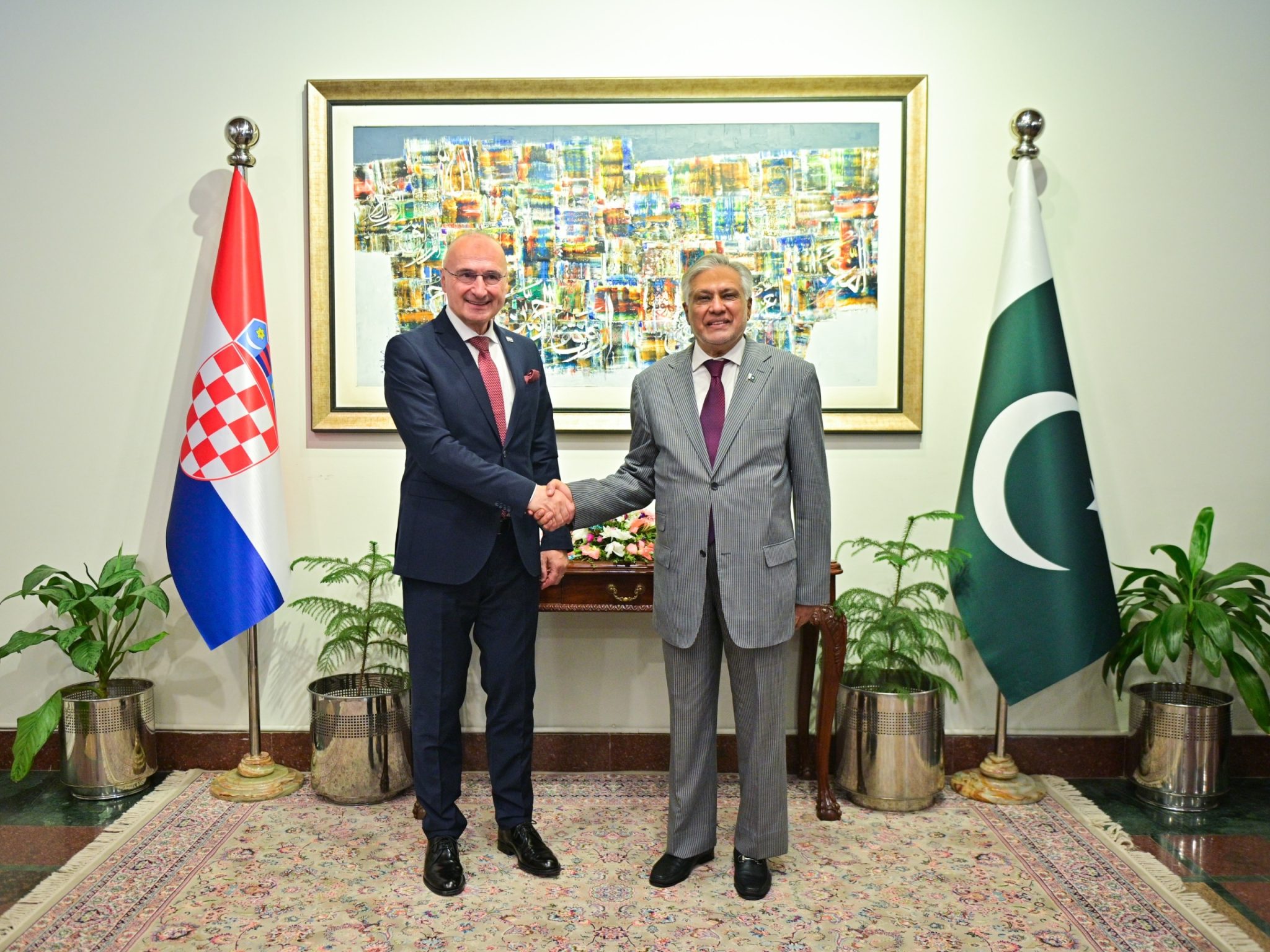
Pakistan, Croatia
vow to further
deepen relations
Croatia closed its embassy in Islamabad in mid-90; ever since there is no formal contact between the two countries
Ansar M Bhatti
ISLAMABAD: Deputy Prime Minister and Foreign Minister Ishaq Dar said on Thursday that Pakistan and Croatia could utilise their geographic locations to unlock the “enormous potential” of their growth.
His remarks came after he met with Croatia’s Minister of Foreign and European Affairs Gordan Grlić Radman, who was in Islamabad on a one-day visit. Croatia closed its embassy in Islamabad in mid-90s and since then there is no direct diplomatic link between the two countries. Croatia has closed its embassy due to security and financial reasons.
Addressing a joint press briefing with Radman, Dar said, “Both Pakistan and Croatia are situated at important geographical locations and could utilise their presence and locations to untap their enormous potential for growth between the two countries and beyond.”
Dar said he briefed Radman on the “potential, capacity, facilities and connectivity of our Karachi port”. “Both sides discussed the possibility of collaborative arrangements between the ports of the two countries,” he added.
The deputy PM noted that connectivity “lies at the heart of a vision for sustainable development, regional stability and global economic integration”.
Dar described the discussions between the two sides held earlier in the day as “warm, constructive and wide-ranging”, adding that both sides reviewed the entire spectrum of Pakistan-Croatia relations.
They “agreed to undertake steps to inject greater momentum to our political and economic relations as well as to enhance our cooperation in all other areas of mutual interest, including trade, investment, development, agriculture, labour mobility, education, defence, via facilitation, climate change, tourism, infrastructure, IT, seaport collaboration, etc”, he said.
Islamabad and Zagreb decided to make a memorandum of understanding (MoU) on bilateral political consultation between their foreign ministries “fully functional and hold the consultation on a regular periodic basis”.
Subsequently, Dar announced Pakistan’s offer to hold the first round of consultations in the last quarter of 2026 or first quarter of 2027.
Speaking on economic collaboration, the deputy premier said both sides “concurred that our bilateral trade remains below its potential”.
“We appreciated the rising trend in bilateral trade volume,” he said, adding that the two countries agreed to “revitalise bilateral economic and trade relations, including through B2B (business-to-business) exchanges for common benefit”.
“We also considered holding a B2B trade forum in the future between the two business communities,” he said.
Dar said he hailed the presence of Croatian companies in Pakistan and invited the other side to “benefit from Pakistan’s favourable investment policies”.
Dar affirmed that Pakistan’s access to the European Union’s (EU) Generalised Scheme of Preferences Plus (GSP+) “remains a cornerstone of Pakistan-EU economic cooperation and a mutually beneficial framework”.
Taking note of a new GSP+ regulation set to enter into force on Jan 1, 2027, Dar said he informed Radman that Islamabad has “already initiated preparatory work for our reapplication in early 2027”.
The two foreign ministers also “agreed to the early finalisation of various agreements and MoUs under process between our two countries”.
Dar further said that the two sides were “working together to expedite the opening of a Croatian visa processing facility in Islamabad”, as applicants currently have to go to Tehran for it. He noted that Radman gave him a “very positive response” to his request for a facility in Islamabad or an alternative.
The Deputy PM said he and Radman discussed ways to strengthen cooperation between the agricultural and research institutes of the two countries. He also invited a department from the University of Zagreb to visit Taxila, the “greatest cosmopolitan centre of learning in the ancient world”.
At the outset of his address, Dar noted that Radman’s trip was the first high-level visit from Croatia to Pakistan in a “long time” and marked an important step in strengthening bilateral relations.
He said Radman was the longest-serving foreign minister of Croatia and played a “key role” in his country’s membership of the EU and Nato.
In his remarks, the Croatian foreign minister observed that bilateral relations between the two nations were based on “friendship and mutual respect”.
“I hope that this visit will help us intensify our relations, enhance our trade and investment and explore new areas, avenues of cooperation,” he said, noting the presence of some Croatian companies in Pakistan since the 1950s.
He expressed his hope that “this successful cooperation encourages greater presence of Croatian products, technologies and services in the Pakistani market”, especially in the pharmaceutical, health, defence, digital, IT, tourism and fuel production sectors.
Radman also invited Pakistani companies to invest in Croatia, noting that his country’s position “opened doors to the European market”.
He highlighted that Croatia has “internationally recognised expertise in humanitarian demining as well as solutions that can support civil protection, disaster response, firefighting and price management operations”.
“With nine strategic airports and six major maritime ports, Croatia can also be a gateway for international travel and cargo,” the minister pointed out.