DNA
A proud new chapter in Pakistan’s history unfolded on Wednesday as Shenzhou-24 spacecraft, carrying the country’s first astronaut, docked with China’s Tiangong space station after a three-and-half-hour-long journey from Earth, according to China Manned Space Agency (CMSA).
The spacecraft carrying Chinese astronauts Tang Hongbo and Wu Yi and Pakistani Muhammad Zeeshan Ali.
The Shenzhou-24 space flight docked at Tiangong at 11:56am (8:56am Pakistan Standard Time) Wednesday, roughly 3-1/2 hours after it took off from the Jiuquan Satellite Launch Centre in northwest China using a Long March-2F rocket.
The Long March 2-F rocket took off in a cloud of flames and smoke at 8:18am (5:18am Pakistan Standard Time) from the Jiuquan launch centre in China’s northwestern Gobi Desert under a pink sky, video from state broadcaster CCTV showed.
The spacecraft successfully separated from the carrier rocket roughly 10 minutes after blast-off and entered into orbit, the CMSA said.
The launch was a “complete success”, the agency said, adding that the crew was in good condition.
Ali is first Pakistani to travel beyond Earth and the first foreign astronaut to visit China’s Tiangong space station, placing Pakistan among the countries taking part in human spaceflight and opening fresh avenues for scientific collaboration with Beijing.
He is travelling as a payload specialist in a three-member crew alongside Chinese astronauts Tang Hongbo, who is commanding the mission, and Wu Yi, the flight engineer.
The spacecraft is carrying the crew to the Tiangong space station, where Ali is expected to spend approximately one week conducting scientific experiments under the Pakistan-China space research programme.
His duties will include installing experimental samples and research equipment, as well as carrying out scheduled experiments.
The scientific work will build on four Pakistani biotechnology experiments selected by Chinese institutions from more than 300 proposals submitted to the Space and Upper Atmosphere Research Commission (SUPARCO) by universities across the country.
The research focuses on areas relevant to food security and climate change, according to details previously shared by Suparco officials with Reuters.
Ali’s flight follows a selection and training process launched after Pakistan and China signed an agreement in February 2025 on selecting and training Pakistani astronauts for missions to the Chinese space station.
Following three rounds of screening and assessment, Ali and Khurram Dawood were selected as astronaut candidates and completed their training in China. Ali was subsequently confirmed for the flight, with Dawood designated as his backup.
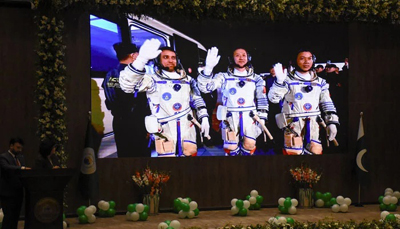
Ahead of the launch, Ali received a ceremonial send-off attended by Pakistani and Chinese delegates, including Federal Minister for Planning, Development and Special Initiatives Ahsan Iqbal.
Speaking to the media after the ceremony, Iqbal described the mission as a moment of immense pride for the nation and expressed hope that it would inspire young Pakistanis to pursue careers in astronautics.
“This is just the beginning, not the end,” he said.
The mission marks the first joint crewed spaceflight involving Chinese and foreign astronauts in China’s human spaceflight programme. It is also expected to open new avenues for Pakistan’s participation in human spaceflight and scientific research.
Pakistan-China space cooperation dates back to the early 1990s, with Beijing having launched several Pakistani satellites over the decades. The partnership is also expected to extend to lunar exploration, with a Pakistani-built rover scheduled to travel aboard a Chinese lunar mission around 2028.
- Ali is set to become the first Pakistani to travel into space and the first foreign astronaut to visit Tiangong.
- He will join Chinese astronauts Tang Hongbo and Wu Yi aboard Shenzhou-24 as a payload specialist.
- The mission will involve four Pakistani biotechnology experiments selected from more than 300 proposals.
- The research focuses on food security and climate change.
- Ali and backup astronaut Khurram Dawood were selected after three rounds of screening and trained in China.
- Pakistan and China signed an agreement in February 2025 to facilitate Pakistani participation in missions to Tiangong.
- The spacecraft is scheduled to launch at 5:18am Pakistan time.
President Asif Ali Zardari has congratulated the nation on Pakistan’s participation in China’s Shenzhou-24 mission, describing it as a “landmark achievement” and a moment of immense national pride.
In a message issued by his office, the president expressed hope that the mission would open new horizons for Pakistan’s space programme and that the scientific experiments conducted during the flight would contribute to research and knowledge.
He said Pakistan’s participation in human spaceflight was not merely about reaching space but also about harnessing its opportunities for research, learning and innovation.
Quoting national poet Allama Iqbal’s verse, “Sitaron se aagay jahan aur bhi hain”, Zardari said the milestone should inspire the country’s younger generation to pursue knowledge, innovation and scientific discovery with confidence and ambition.
Prime Minister Shehbaz Sharif has described Pakistan’s participation in the Shenzhou-24 mission as a historic moment belonging to the entire nation, saying the country is looking towards the skies with “anticipation, pride and deep gratitude”.
In a post on X, the prime minister paid tribute to the Space and Upper Atmosphere Research Commission (SUPARCO), academic institutions, scientists, the armed forces and other national institutions for their contributions to the achievement.
He also thanked Chinese President Xi Jinping, saying his leadership and commitment to Pakistan-China friendship had taken the two countries’ All-Weather Strategic Cooperative Partnership to unprecedented heights.
Sharif described the mission as a testament to the “exceptional trust, mutual respect and enduring brotherhood” between the two countries and wished the crew a safe and successful flight.
“Pakistan-China friendship is surpassing the heights of the Himalayas, in its journey to outer space,” he wrote.