ISLAMABAD, AUG 31 /DNA/ – Federal Minister for Finance and Revenue, Senator Muhammad Aurangzeb, attended Pak EXIM’s “Partnerships That Power Progress” event as Chief Guest today, where he underscored the importance of building a sustainable, export-led and private-sector-led growth model for Pakistan.
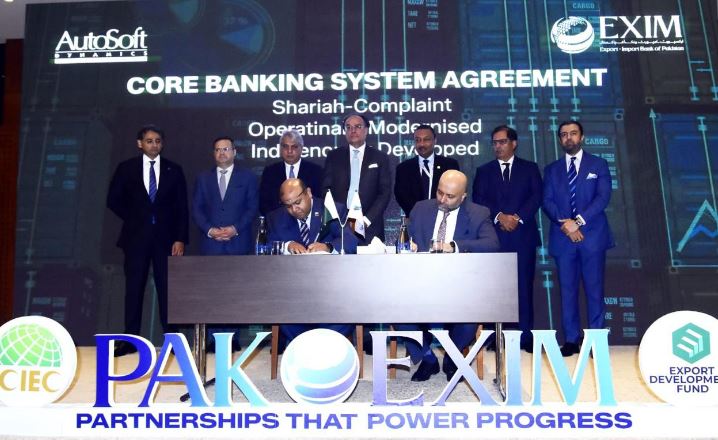
The event marked the signing of two strategic agreements aimed at strengthening Pakistan’s export financing and risk-sharing architecture: a reinsurance agreement between the Export-Import Bank of Pakistan (Pak EXIM) and the Islamic Corporation for the Insurance of Investment and Export Credit (ICIEC), and an approximately Rs3 billion SME Risk Pool between the Export Development Fund (EDF) and Pak EXIM.
Addressing senior government officials, exporters, representatives of the banking and business communities and development partners, the Finance Minister noted that Pakistan was steadily moving from stabilization towards growth. He highlighted that after contracting a few years ago, the economy grew by around 3.7 percent in FY26, while the fiscal deficit declined to 2.6 percent of GDP, its lowest level in 22 years. Pakistan has also recorded primary surpluses for three consecutive years, while the external account has undergone a substantial adjustment.
Senator Muhammad Aurangzeb said the country now had an important opportunity to move away from the recurring boom-and-bust cycles of the past, which had been driven in large part by import dependence and resulting balance-of-payments pressures whenever growth accelerated. He emphasized that the central challenge was not merely achieving growth, but ensuring its sustainability, for which export-led and private-sector-led growth would be critical.
The Finance Minister said the Government’s role was to provide the enabling ecosystem and utilize the fiscal and external space created through stabilization to facilitate investment, competitiveness and exports.
He highlighted that the FY27 Budget had provided a clear direction of travel towards export-led growth through a series of measures, including tax relief for exporters, removal of the advance tax on exports, substantial reduction in Super Tax, including its elimination for qualifying companies deriving more than 80 percent of their turnover from exports, measures towards improving energy competitiveness, and continued provision of competitive export financing.
Senator Muhammad Aurangzeb noted that despite the recent movement in the policy rate amid imported inflationary pressures, financing was being made available to exporters at 4.5 percent, ensuring continued access to competitive export financing.
Against this backdrop, the Finance Minister described Pak EXIM as a critical institutional enabler for channeling export refinance and long-term financing, including through the Export Finance Scheme (EFS) and Long-Term Financing Facility (LTFF).
He stressed the need to continue supporting Pakistan’s traditional export sectors while simultaneously diversifying the export base across new products, services, markets and exporter segments. He particularly emphasized expanding access to competitive financing for SMEs and businesses operating across exporters’ value and supply chains, so that financing support extended beyond larger final exporters to smaller enterprises contributing to export production.
The Finance Minister noted the strong gains already being witnessed in services exports, including IT exports of around US$4.6 billion and freelancer earnings of around US$1.7 billion. At the same time, he emphasized the need for a significantly larger and more diversified expansion in goods exports, noting that incremental growth around the existing US$30 billion base would not be sufficient to meet Pakistan’s ambitions.
He underscored that Pakistan needed improvement not only in the quantum of exports, but also their quality, through greater diversification into new markets, segments, products and services.
Turning to the agreements signed at the event, Senator Muhammad Aurangzeb welcomed the Pak EXIM–ICIEC reinsurance partnership, noting that it would bring international expertise in credit and political-risk mitigation while strengthening Pak EXIM’s capacity, confidence and credibility.
The agreement was signed by Dr. Khalid Khalafalla, Chief Executive Officer of ICIEC, and Mr. Shahbaz Hussain Syed, President & CEO of Pak EXIM, during the high-level visit of an ICIEC delegation to Pakistan. ICIEC is a member of the Islamic Development Bank Group.
The reinsurance partnership will strengthen Pak EXIM’s underwriting capacity and enable it to expand Trade and Export Credit Insurance coverage, helping a larger number of Pakistani exporters manage commercial and political risks associated with international trade.
The Finance Minister emphasized the importance of drawing upon the experience of established international export credit agencies and institutions and bringing international best practices and expertise into Pak EXIM to accelerate the institution’s development and capacity.
Senator Muhammad Aurangzeb also welcomed the approximately Rs3 billion SME Risk Pool between EDF and Pak EXIM, signed by Mr. Omar Saeed, Chairman EDF, and Mr. Shahbaz Hussain Syed, President & CEO of Pak EXIM.
He noted that the arrangement would strengthen domestic risk-sharing and help expand SMEs’ access to export credit insurance. The Finance Minister emphasized that EDF resources should increasingly support interventions that expand Pakistan’s export base and generate the additional exports required to sustain higher economic growth.
The SME Risk Pool will facilitate SMEs’ access to Pak EXIM’s Trade and Export Credit Insurance against non-payment risks, providing smaller exporters greater protection and confidence to pursue new customers and export destinations.
The Finance Minister also welcomed the growing role of the private sector in EDF’s governance and decision-making, noting that a genuinely private-sector-led growth model required the private sector to play an active role in shaping and driving export-support interventions.
Reflecting on the broader significance of the event, Senator Muhammad Aurangzeb noted that while the “what” and “why” of export-led growth had been discussed extensively over the years, initiatives such as the partnerships announced today were increasingly addressing the “how” of delivering export-led growth.
He emphasized that no single institution could deliver Pakistan’s export ambitions independently and stressed the importance of an integrated export ecosystem bringing together exporters, commercial banks, EDF, Pak EXIM, the State Bank of Pakistan and the Government. He said the objective should be to build capacity across this ecosystem, both in terms of the quantum and quality of Pakistan’s exports.
Speaking on the occasion, Mr. Shahbaz Hussain Syed, President & CEO of Pak EXIM, said the agreements represented an important step forward for Pakistan’s exporters. He noted that the ICIEC reinsurance partnership would significantly strengthen Pak EXIM’s underwriting capacity, while the EDF SME Risk Pool would complement it by expanding SMEs’ access to insurance against non-payment risks and enabling them to pursue new markets with greater confidence.
Dr. Khalid Khalafalla, CEO of ICIEC, said the partnership with Pak EXIM represented an important step in strengthening Pakistan’s export ecosystem. He noted that by combining their respective capabilities, the institutions aimed to support more exporters, widen access to risk protection and contribute to greater trade diversification and competitiveness.
Senator Muhammad Aurangzeb appreciated the leadership and progress made by Pak EXIM in a relatively short period and reaffirmed the Ministry of Finance’s support for strengthening the institution and Pakistan’s wider export ecosystem.
The Finance Minister emphasized that the broader objective was to translate the economic stability achieved over recent years into a growth model in which private investment, productive capacity, SMEs, diversification and exports increasingly drive economic expansion, employment and foreign-exchange earnings.
Concluding his remarks, Senator Muhammad Aurangzeb stressed that the real measure of success would go beyond the signing of agreements to their effective implementation and ability to translate into greater financing capacity, stronger risk protection, new exporters, new markets and additional exports. He reaffirmed the Government’s commitment to providing the necessary support and enabling environment to advance Pakistan’s export-led and private-sector-led growth agenda.