
DNA
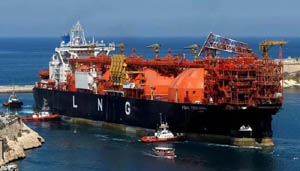
ISLAMABAD: Pakistan is expected to receive a Qatari LNG cargo within the next three to five days, as a vessel carrying the shipment has crossed the Strait of Hormuz and reached Omani waters, The DNA News reported . The LNG vessel, Al Mafyar, arrived in Omani waters on Tuesday after successfully crossing the Strait of Hormuz. As the vessel is a large Q-Max carrier, the LNG is expected to be transferred somewhere en route to relatively smaller vessel, one possibly named as Ejnan, which could then arrive in Pakistan within the next three to five days, top officials privy to the development have said. “This is the first LNG cargo that Pakistan has arranged from Qatar with the reported assistance of Iranian authorities. Pakistan is likely to arrange two smaller LNG vessels through ship-to-ship transfers from the Q-Max carrier. And one LNG cargo that will be the third one is expected to be arranged for Pakistan soon.” QatarEnergy has already extended its force majeure until November. However, Pakistani authorities managed to arrange the cargo at a price equivalent to 13.37% of Brent after contacting Iran’s senior leadership. If Pakistan manages to secure two more cargoes for October, there will be no immediate need to procure additional spot LNG during the month. Spot LNG is currently available in the range of $28-30 per MMBtu, meaning a single cargo could cost around $100 million — an exceptionally high burden for a country like Pakistan. In September, Pakistan arranged two LNG cargoes from Qatar. One arrived on September 10, while the second reached the country on September 23. The possibility of a prolonged force majeure by QatarEnergy has nevertheless raised serious concerns over whether Pakistan will be able to secure the required number of LNG cargoes during the critical winter months. There are, however, reports that QatarEnergy has accumulated a large number of empty Q-Flex LNG carriers, indicating that the company intends to resume LNG exports on a significant scale. QatarEnergy has also intensified diplomatic efforts involving the United States and Iran aimed at securing a longer-lasting truce in the region. Officials estimate that Pakistan will require around nine LNG cargoes in December, while demand could rise to approximately 11 cargoes in January 2027, when the country traditionally experiences peak winter gas requirements. At present, power load-shedding has increased across the country, with authorities citing limited availability of RLNG for power generation. The available RLNG is reportedly insufficient to eliminate power outages, while demand is expected to rise sharply as winter progresses. Officials have warned that if the force majeure continues from mid-November 2026 through February 2027, the gas supply situation could become extremely tight. Under such a scenario, RLNG supplies to several major sectors — including power generation, export-oriented industry, non-export industry, commercial consumers, general industry, cement and CNG — could face severe restrictions. System gas would have to be prioritised for domestic consumers, particularly for cooking and other essential household needs. Officials have also cautioned that even consumers currently receiving system gas could increasingly be forced to switch to LPG cylinders if the winter supply gap widens. The expected LNG shortfall could consequently trigger a sharp increase in LPG demand, putting additional pressure on both availability and prices.
Officials said the government would need to ensure adequate LPG supplies in the domestic market at affordable prices before the winter shortage becomes acute. They warned that an 11.8-kilogram LPG cylinder could rise to Rs7,000 or more in the open market if supply constraints intensify, compared with prices of more than Rs5,000 currently being reported in the open market — significantly higher than the prices notified by the Oil and Gas Regulatory Authority (Ogra). Such an increase would place another burden on households already facing higher energy costs, particularly in areas where piped gas supplies become inadequate during the winter months. On the infrastructure side, officials said the Engro LNG terminal is currently available, as the LNG cargo that berthed on September 10 has already been consumed. The Pakistan GasPort Limited (PGPL) terminal, meanwhile, has slowed down regasifying the LNG cargo that arrived on September 23. For now, the government is focusing on arranging three October cargoes from Qatar while working to keep diplomatic channels open over the Strait of Hormuz. The coming weeks could prove crucial for Pakistan’s winter energy security, with the government facing a difficult balancing act between securing expensive spot LNG, negotiating additional supplies and managing increasingly tight domestic gas availability. If Qatar’s force majeure extends further into the winter, officials fear Pakistan could face not only an LNG supply crisis but also a sharp increase in LPG demand and prices, turning the approaching winter into a major test of the country’s energy management.