PESHAWAR, Nov 25 (DNA):For thousands of low-income families, salaried employees and pensioners across Khyber Pakhtunkhwa, owning a home has long remained an elusive dream, overshadowed by soaring rents, rising property prices and inflation that steadily erodes household incomes for last 13 years.
But the Prime Minister, Muhammad Shehbaz Sharif’s Apna Ghar Programme (Ghar Ho Tu Apna), offering subsidized housing finance, has rekindled hopes among ordinary citizens of finally having a place they can call their own, bringing the promise of financial relief, security and dignity.
The release of Rs 112.3 billion in housing finance, alongside the approval of substantial loans under the programme, has been described by political leaders and economic experts as a significant step towards making homeownership accessible to deserving families.
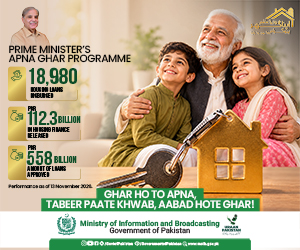
Former provincial minister and PML-N leader Wajid Ali Khan said the disbursement of 18,980 loans and approval of Rs 558 billion in financing as of November 13, strongly reflected strong institutional support and growing public interest in the historic initiative.
He said response of poor people to the landmark program was overwhelming as they knew that it was a golden opportunity to become master of their own houses.
He said the programme had emerged as a ray of hope for homeless and underprivileged families, enabling them to invest in their future rather than spend a lifetime paying rent.
For retired schoolteacher Fayaz Khan, living in a modest rented house in Peshawar, the struggle to make ends meet has become increasingly difficult as rents rise while pension income remains limited.
“Every year my landlord increases the rent, but my pension hardly increases,” he said, explaining how a significant portion of his monthly income went towards housing expenses, leaving little for groceries, medicines and other necessities.
Having spent his entire life serving through education, he said his biggest wish was to own a small house where his children and grandchildren could live with dignity and security.
“When I heard about the Prime Minister’s Apna Ghar Programme, it felt like someone had finally listened to the hardship and struggles of ordinary people,” he said in an emotional tone.
“A house is not just bricks and cement. It is peace of mind, security for children and respect for a family,” he shared.
His story reflects the aspirations of hundreds of thousands of families in KP especially in Peshawar, Mardan, Swat and Abbottabad, where rising housing costs have made it increasingly difficult for middle- and low-income households to secure permanent accommodation.
Asmat Khan, a corporate-sector employee who has spent years paying rent from his salary at Peshawar, said the initiative had created widespread optimism among families struggling to meet housing expenses.
“For the first time, we feel that owning a house is now possible in Peshawar,” he said, adding that the simplified application process, affordable markup and financing facility of up to Rs10 million had encouraged people from different walks of life to apply and become master of their own houses.
“Every parent dreams of leaving behind a home for their children. This programme gives us the confidence that this dream can become a reality,” he said.
He added that a permanent home offered benefits far beyond shelter, providing stability for families, improving children’s educational prospects, strengthening family relationships and contributing to physical and mental well-being.
Professor Dr Muhammad Naeem at University of Swabi’s economics department described affordable housing as a fundamental human necessity rather than a luxury, saying the initiative could help address a longstanding housing crisis confronting the province and the country.
He said rapid population growth, urbanisation, migration from rural areas and rising land prices had significantly widened the housing gap, particularly in major urban centres of Khyber Pakhtunkhwa.
Pakistan’s population crossing the 245 million mark has intensified pressure on urban infrastructure and housing facilities, while the province faces a substantial shortage of residential units, he said.
According to housing estimates, Khyber Pakhtunkhwa requires hundreds of thousands of additional houses to accommodate its growing population and address the accumulated housing deficit, with Peshawar, Mardan, Swat and Abbottabad facing mounting pressure.
Dr Naeem said investment in affordable housing could generate economic activity, create employment opportunities, strengthen social stability and improve living standards, stressing the need for sustainable short- and long-term housing policies.
He, however, cautioned that unplanned urban expansion and conversion of agricultural land into residential colonies could pose serious challenges to food security, environmental sustainability and urban infrastructure.
Relocating families to distant urban outskirts without adequate transport, educational, healthcare and employment facilities could also create additional social and economic hardships, he said, underscoring the importance of integrated urban planning.
Under the Prime Minister’s Apna Ghar Programme, commercial banks, Islamic banks, microfinance institutions and the House Building Finance Company Limited (HBFCL) are accepting applications through designated branches and digital platforms.
The programme offers financing for houses measuring up to 10 marla and flats of up to 1,500 square feet, with loans of up to Rs 10 million, a fixed markup of five percent and government subsidy on markup for the first 10 years.
Financing is available for a period of up to 20 years, while applicants are required to contribute 10 percent equity. The scheme also provides for zero processing charges and no prepayment penalties, alongside risk-sharing support for participating financial institutions.
According to figures cited by banking officials, participating financial institutions have approved substantial housing finance under the programme, while disbursements are enabling eligible applicants to move closer to their homeownership goals.
Former Minister Wajid Ali Khan termed the initiative a lifeline for homeless families, saying access to affordable financing could help thousands escape the financial burden of rented accommodation.
“There is no greater gift for a homeless family than the keys to their own home,” he remarked.
Meanwhile, the Provincial Housing Authority (PHA) is pursuing several housing projects to address the province’s growing residential needs, including Hangu Township, Jalozai Phase-III in Nowshera, residential apartments in Peshawar, a housing tower in Nishtarabad and the Surizai Housing Scheme.
The projects, alongside federal housing finance initiatives, are expected to contribute towards bridging the housing gap, although experts emphasise the need for sustained investment, transparent implementation and effective planning.
For families who have spent years adjusting household budgets around rent payments, the prospect of owning a permanent home carries a meaning far deeper than property ownership.
It represents freedom from the uncertainty of rent increases, a secure future for children, the comfort of ageing parents and the opportunity to build a lasting family legacy.
For many deserving households across Khyber Pakhtunkhwa, the Apna Ghar Programme is therefore not merely a financing facility but a renewed promise that the dream of a home may finally be within reach.