
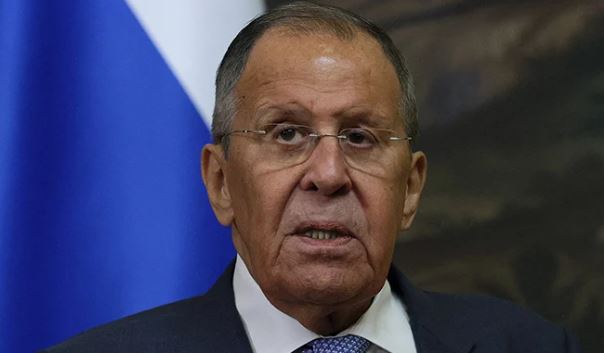
MOSCOW: Russian Foreign Minister Sergey Lavrov has called for Iran to be included in a regional security framework for the Gulf, saying its participation would be an important step towards regional stability, according to Turkish news agency Anadolu.
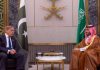
Lavrov’s remarks came as he discussed the Makkah Joint Defence Pact signed by Pakistan, Saudi Arabia and Turkiye on August 7 as a possible framework for broader regional security cooperation.
The trilateral agreement provides for collective security and defence cooperation among the three countries, with the Strategic Political and Defence Committee established under the pact holding its inaugural meeting in Istanbul on August 31.
The pact was signed amid heightened tensions in the Middle East following the conflict that began on February 28, when the United States and Israel launched joint strikes against Iran and targeted its senior leadership.
Pakistan and Saudi Arabia had also previously signed a mutual defence agreement under which aggression against either country would be treated as an attack on both.
Turkish President Tayyip Erdogan, Saudi Crown Prince Mohammed bin Salman, and Pakistans Prime Minister Shehbaz Sharif sign a joint defence agreement in Makkah, Saudi Arabia, August 7, 2026. — Reuters
Turkish President Tayyip Erdogan, Saudi Crown Prince Mohammed bin Salman, and Pakistan’s Prime Minister Shehbaz Sharif sign a joint defence agreement in Makkah, Saudi Arabia, August 7, 2026. — Reuters
Lavrov made the remarks on Monday while speaking to students and faculty at the Moscow State Institute of International Relations (MGIMO), where he outlined Moscow’s long-standing approach to security cooperation in the Gulf.
He recalled that Russia had proposed more than two decades ago that Gulf countries, including the Arab countries and Iran, consider holding a meeting to develop a regional security concept.
“Recognising that relations between them are complex, we proceeded from the assumption that we would facilitate meetings, discussions of mutual grievances, and agreement on certain confidence-building measures,” he said.
“We believed these discussions would be easier to organise if the Arab League, the Organisation of Islamic Cooperation, and the five permanent members of the UN Security Council were involved simultaneously,” he added.
Lavrov said the regional situation changed after the United States and Israel launched a joint military operation against Iran in February.
Iranian President Masoud Pezeshkian attends a session of the Shanghai Cooperation Organisation (SCO) summit in Bishkek, Kyrgyzstan September 1, 2026. — Reuters
Iranian President Masoud Pezeshkian attends a session of the Shanghai Cooperation Organisation (SCO) summit in Bishkek, Kyrgyzstan September 1, 2026. — Reuters
He also referred to the normalisation of relations between Iran and Saudi Arabia, which followed a Chinese initiative with what he described as active encouragement from Moscow.
Turning to the possibility of expanding the Makkah pact’s framework, Lavrov said its proponents had indicated that membership could remain open to countries beyond the Gulf.
“Egypt is often mentioned. I am sure that if Algeria shows interest, that too would have a positive effect at some stage,” he said.
Lavrov said agreeing on terms for Iran’s participation in such a structure could be a “most practical step” towards the security model originally proposed by Moscow.
The Russian top diplomat said Moscow would not seek a leading role in any such regional security arrangement.
Regional powers are seeking stronger security ties amid the US-Israel war on Iran, which has disrupted regional stability and maritime traffic through the Strait of Hormuz.
Turkiye has Nato’s second-largest military, while Saudi Arabia is a major Gulf power and oil exporter, and Pakistan is the only nuclear-armed Muslim country.
On August 9, Deputy Prime Minister and Foreign Minister Senator Ishaq Dar said the Makkah pact remained open to countries willing to uphold its core principles, stressing that it was defensive in nature.
DPM Dar said the agreement was not directed against any country and aimed to promote regional peace, stability and prosperity through mutual respect, cooperation and peaceful means.