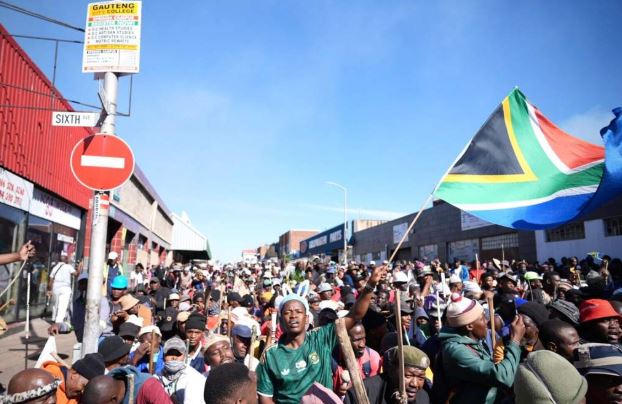
CAPE TOWN, JUN 15: South African companies with operations across Africa are facing mounting pressure as anti-immigrant protests in the continent’s largest economy trigger diplomatic tensions and calls for action against their businesses.
Mobile-phone operator MTN Group has dispatched a senior executive to meet officials in Ghana and is supporting Nigerians repatriated from South Africa, while Standard Bank Group, the continent’s biggest lender, says it is closely monitoring developments.
Gold Fields, which operates the Tarkwa gold mine in Ghana, is navigating a tougher policy environment as authorities push for greater local participation in the mining sector and now risks coming under further political pressure.
More than 2 700 people from Ghana, Nigeria, Mozambique and Malawi have been assisted to return home from South Africa amid fears that anti-immigrant demonstrations could escalate, with a number having already been attacked and had their homes or businesses looted. Meanwhile, 7 400 undocumented migrants have been arrested for contravening immigration laws over the past month, bringing the number detained so far this year to more than 40 000, according to the Department of Home Affairs.
The growing backlash against anti-immigrant protests illustrates the risks faced by South African corporations with continent-wide operations. The dispute has intensified in recent days, with Ghana’s Foreign Minister Samuel Okudzeto Ablakwa calling on the African Union to debate the treatment of African migrants in South Africa.
In Nigeria, Foreign Affairs Minister Bianca Odumegwu-Ojukwu indicated that the government is considering possible measures against South Africa following the repatriation of Nigerian citizens. And in Ghana, activists are pressing authorities to take a harder line against South African companies operating in the country.
The risk is particularly acute for South African firms whose growth depends on operations beyond their home market. MTN’s Nigerian business is its largest, Standard Bank is present in more than a dozen African countries, and Gold Fields’ Tarkwa mine in Ghana ranks among its most important assets.
Ebenezer Asante, MTN’s senior vice president for markets, has been sent to meet Ghana’s foreign affairs and trade ministers. In Nigeria, the company is working with authorities to support 1350 citizens who returned from South Africa on a charter flight last week, providing them with SIM cards, data and a cash grant.
“We have not seen impacts specifically to our business, but we’re very sensitive in markets such as Nigeria and Ghana,” CEO Ralph Mupita said in an interview.
“MTN makes less than 20% in South Africa and makes 80% of our earnings elsewhere,” he said. “We were birthed in South Africa, but we are a pan-African organisation now.” He said the company continued to engage governments on what he described as a complex issue requiring broader regional solutions.
Standard Bank remains “focused on the safety and well-being of our employees and clients, as well as the uninterrupted delivery of services through our operations,” the lender said in an emailed response.
For Gold Fields, the current tensions have erupted against a backdrop of a shifting political landscape in Ghana. The government has signalled that mining lease renewals will no longer be automatic and has sought deeper local participation in the sector, increasing scrutiny of foreign operators.
While that debate predates the current protests, it risks adding momentum to calls for a tougher stance toward foreign-owned entities.
“We are currently engaged in the process of renewing the Tarkwa mining lease,” with a decision expected by the end of 2026, Gold Fields said in response to questions. “Discussions with the government of Ghana in this regard remain constructive and are taking place through the appropriate channels.”
In Ghana, a group called the Ghana First Alliance presented a petition to the presidency last week demanding stronger action to protect the country’s nationals. It wants South African businesses to be subjected to greater scrutiny and for Pretoria to be held accountable, its convener Nana Otu Darko said.
South Africa’s relative wealth has long made it a destination for migrants from across the continent. Per-capita gross domestic product is about $7 500, compared with roughly $1 080 in Nigeria. The country is home to about 3 million immigrants, the majority originating from elsewhere in Africa.
The latest demonstrations have been fueled by perceptions that foreign nationals contribute to unemployment, crime and pressure on public services.
Those concerns have periodically erupted into violence, most notably in 2008 when more than 60 people were killed and about 50 000 were displaced in a spate of xenophobic attacks.
“The brand is hurting,” Justice Minister Mmamoloko Kubayi told reporters on Sunday, when asked about the impact of the latest violence on South Africa’s international reputation. “We can’t lie about that.”