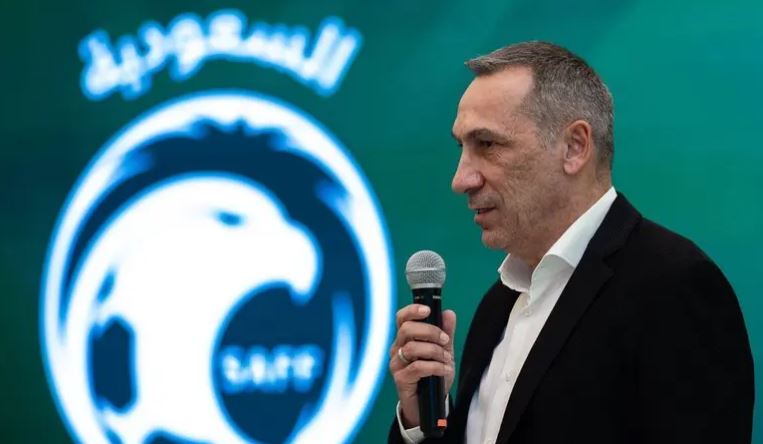
RIYADH, MAY 26: Recently appointed Saudi Arabia head coach Georgios Donis has named his preliminary 30-man squad for the 2026 FIFA World Cup, with the Green Falcons’ final 26-player roster due to be confirmed on June 2.
The squad is headlined by captain Salem al-Dawsari, France-based full-back Saud Abdulhamid and a strong core of players from the side that famously defeated Argentina at the 2022 World Cup in Qatar. Recently crowned AFC Champions League winners Al Ahli provide five players, while ambitious clubs such as Al Qadsiah and NEOM SC are also increasingly represented in a squad that largely prioritizes continuity and Saudi Pro League experience over radical change.
Donis and his Saudi Arabia players will prepare for the tournament with training camps in New York and Texas before friendlies against Ecuador, Puerto Rico and Senegal as Donis begins shaping his first major tournament side.
Here, Al Arabiya English explores the major talking points from Saudi Arabia’s preliminary World Cup squad.
Heroes of Argentina side still the core
Four years on from arguably the greatest result in Saudi football history, much of the side that stunned Argentina in Lusail remains central to the national team setup.
Of the starting XI that defeated the eventual world champions at Qatar 2022, seven players are included again for World Cup 2026: Mohammed al-Owais, Saud Abdulhamid, Hassan al-Tambakti, Firas al-Buraikan, Mohamed Kanno, Salem al-Dawsari and Saleh al-Shehri. Now captain for club and country, al-Dawsari – who scored the winner against Argentina – remains the squad’s inspirational figurehead.
The Al Hilal winger heads into another World Cup as Saudi Arabia’s most influential attacking player and still one of Asian football’s leading lights. Four years after scoring the winning goal against Argentina, al-Dawsari remains central to the Green Falcons’ hopes of progress from the group stage in North America.
Several others from the iconic victory over Argentina remain active but have dropped out of the World Cup picture – including former captain Salman al-Faraj, who is perhaps the most high-profile omission from Donis’ squad. An injury-plagued few years for al-Faraj meant that, until this March, he had only played twice for the Green Falcons since the Argentina win.
Former coach Herve Renard had brought the experienced midfielder in from the international wilderness for friendlies against Egypt and Serbia and it seemed he might make it to a final World Cup with the national team, but there was no room for sentiment from Donis.
Yasser al-Shahrani, Ali al-Bulayhi and Abdulellah al-Malki are also absent from the Green Falcons’ World Cup roster. The three played against Argentina and had played a role during FIFA World Cup qualifying, though none of them had turned out for the Green Falcons since 2024. The result is a squad that still leans heavily on the experience of Qatar 2022, but is in gradual transition towards a new generation of Saudi talent.
Donis prioritizes continuity
For a coach appointed only a month before naming his squad, Donis has largely avoided dramatic experimentation. Only one uncapped player appears in the 30-man Saudi group: Alaa al-Hejji, rewarded after an outstanding season with NEOM. The 30-year-old midfielder’s inclusion reflects the growing influence of clubs outside Saudi Arabia’s traditional elite.
Beyond that, however, Donis has largely trusted experienced international players already familiar with major tournament football and the demands of international competition.
That approach should not come as a major surprise given the Greek coach’s long history in Saudi football. Across spells with Al Hilal, Al Wehda and Al Fateh, Donis has often favored tactical organization, defensive structure and experienced players capable of executing clearly defined roles.
Speaking after naming the squad, the 56-year-old stressed that building confidence and unity would be one of his major priorities before the tournament.
“I believe in their abilities, so my priority now is for them to believe in their abilities,” Donis said. “We cannot promise miracles, but we promise you that we will give our all to achieve our goals.
“The current squad includes many players who have played a lot of minutes with their clubs this season. I believe all the players have the ability and passion required to commit to our plan, which will enable us step-by-step to build a strong and united team.
“I have spent many years in Saudi Arabia and I know the culture of the country and the players,” he said. “Therefore, we want to be very competitive and fight hard.”
Al Qadsiah’s rise reflected
The growing influence of Al Qadsiah is clear to see in the Green Falcons squad, with the inclusion of midfielder Musab al-Juwayr, who turns 23 during the tournament and is the youngest player in the squad, plus defenders Jehad Thakri and Mohammed Abu al-Shamat, and goalkeeper Ahmed al-Kassar.
Yet the standout story is undoubtedly the recall of Abdullah al-Salem. At 33, the forward is preparing for his first FIFA World Cup after previously winning only three international caps. Al-Salem made his debut as a substitute against China in World Cup qualifying last year before featuring off the bench twice in the CONCACAF Gold Cup.
His late-career rise mirrors Al Qadsiah’s own emergence as one of Saudi football’s fastest-rising projects. The scale of Al Qadsiah’s representation also highlights how Saudi football’s balance of power has evolved since Qatar 2022, when the national team setup was overwhelmingly dominated by Al Hilal players.
Big omissions despite strong seasons
Although the squad contains relatively few major surprises, several omissions will still generate debate. Rayan Hamed perhaps has the strongest case for inclusion after impressing throughout Al Ahli’s AFC Champions League-winning campaign, while fellow Ahli defender Mohammed Sulaiman also misses out despite strong domestic performances – particularly early in the season.
Had the World Cup been last summer, Al Ittihad’s Saad al-Mousa would have surely been on the plane after playing a role in his club’s 2024-25 Saudi Pro League title success. But al-Mousa has been used sparingly this season and has not featured for the Green Falcons since the 0-0 World Cup qualifying draw with Iraq last October.
Perhaps the most intriguing omission, however, is Marwan al-Sahafi. Few Saudi players have taken the bold step of moving overseas in recent years, making al-Sahafi’s progress with Royal Antwerp particularly significant. The winger enjoyed an encouraging campaign in Belgium and many expected that experience abroad would strengthen his World Cup credentials.
Instead, Donis has opted against selecting one of Saudi football’s rare European-based players – a decision likely to fuel wider debate about how overseas experience is currently valued within the national team setup.