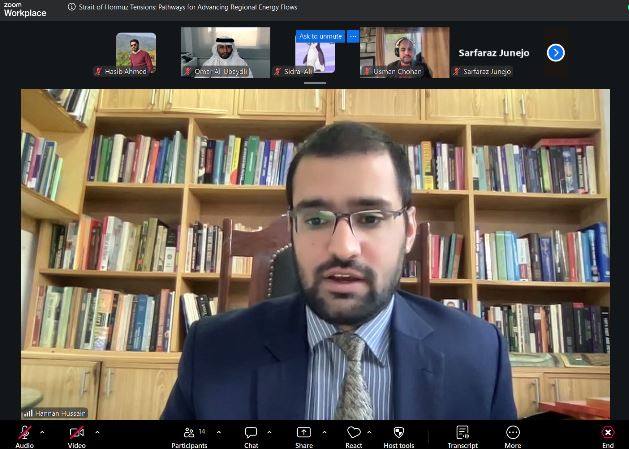
ISLAMABAD, MAY 26 /DNA/ – The Institute of Regional Studies hosted a webinar on “Strait of Hormuz Tensions: Pathways for Advancing Regional Energy Flows,” featuring Dr. Omar Al-Ubaydli, Research Director at the Bahrain Center for Strategic, International and Energy Studies as the principal Speaker.
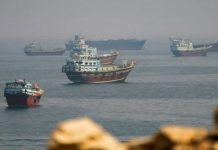
The discussion centered on how the Strait of Hormuz crisis illustrates the deep interconnection between geopolitics, energy security, and global supply chains. The webinar opened with remarks emphasizing the Strait of Hormuz as a vital artery for global energy flows and a central pillar of regional economic stability, particularly for energy-importing economies such as Pakistan and others across Asia.
Dr. Omar Al-Ubaydli highlighted that recent geopolitical tensions have significantly intensified existing vulnerabilities in global supply chains, warning that the crisis represents one of the most severe disruptions to global energy systems in recent history. He noted that the Strait of Hormuz remains indispensable for both exports and imports of Gulf economies, while also serving as a critical transit point for global energy and industrial supply chains extending to China, South Korea, Europe, and beyond.

He emphasized that today’s global economy is far more integrated than in previous decades, making it significantly more vulnerable to disruptions in maritime choke points. Even countries that are not directly engaged in regional conflicts, such as the United States, are indirectly affected through global oil price fluctuations, which in turn influence domestic economic conditions and political behavior. The crisis, therefore, is not isolated but embedded in a highly interdependent international system where shocks travel quickly across regions and sectors.
A key theme of the discussion was the multi-dimensional impact of the Strait of Hormuz disruption to regional economies, particularly in the Gulf and neighboring states like Pakistan. Beyond maritime trade, the conflict has affected airspace accessibility, cargo logistics, and the functioning of regional transport hubs such as the United Arab Emirates, Qatar, and Saudi Arabia. For Pakistan, the effects are compounded by its reliance on imported energy, exposure to oil price volatility, and the economic importance of its diaspora in the Gulf whose remittances and mobility have been disrupted. The speaker also highlighted Pakistan’s emerging diplomatic role as a mediator, which, while strategically significant, also carries economic and administrative costs in terms of coordination, security, and sustained diplomatic engagement.
Towards the end, the discussion highlighted two key policy lessons. First, economic interdependence alone does not guarantee peace and may, in some cases, be weaponized as a tool of coercion rather than cooperation. Second, emerging technological asymmetries particularly in unmanned and low-cost weapon systems require urgent investment in adaptive, cost-effective defensive strategies. Without such measures, both state and non-state actors will retain the ability to disrupt critical global infrastructure at relatively low cost.