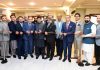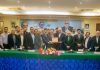

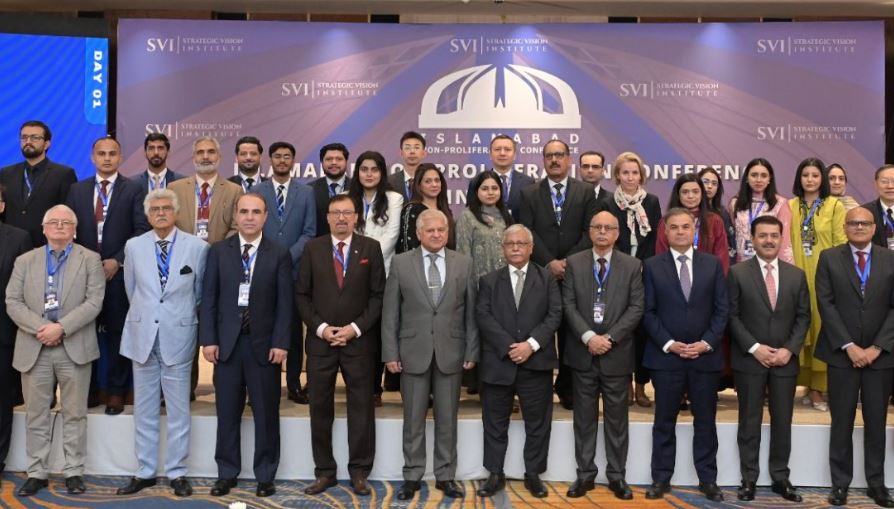
ISLAMABAD, Oct 20 (DNA):The Strategic Vision Institute (SVI), Islamabad, hosts the second iteration of Islamabad Non-Proliferation Conference 2026, a two-day international event bringing together a distinguished group of scholars and experts from around the world.
The conference aims at fostering constructive dialogue on global strategic issues and sharing Pakistan’s policy perspectives. Dr Naeem Salik, Executive Director (ED), SVI, welcomed the distinguished guests to the International Nonproliferation Conference (INC) 2026. Dr Nasir Hafeez, Director, SVI, subsequently introduced the conference to the esteemed audience.
The inaugural address was delivered by Lt. Gen. Sarfraz Sattar, HI (M), (Retd.), Advisor, NCA. He mentioned that the disruptive technologies sit at the heart of the push towards bigger and better Nuclear Weapons, against the efforts of restraint or stability on the road to disarmament and sustained economic development.
He said, that there has been a shift in the nuclear age marked by the change of threat perception from rouge or non-state actors getting access to nuclear weapons towards the challenge of Great Power Competition and the possibility of interstate conflict in a more contested international system.
He mentioned South Asia as a nuclear flashpoint, owing to India’s ultranationalist tendencies. We face Hindutva ideology which is in pursuit of Akhand Bharat. He further mentioned that the nuclear non-use taboo seems to be weakening as we see the likelihood of interstate wars increasing both in lethality and expense. The sole function of global nuclear order is also under extreme stress.
Lt. Gen. Khalid Ahmed Kidwai, (Retd.), Advisor Development, National Command Authority (NCA), delivered the keynote address. He examined Pakistan’s perspective on credible deterrence, strategic balance, and strategic stability in South Asia, tracing their evolution in the pre-May 2025 conflict period and assessing their implications in the post-conflict strategic environment. Lt Gen. Kidwai (Retd.) emphasized that Pakistan’s Full Spectrum Deterrence (FSD) is fundamentally defensive, aimed at preventing aggression across the entire spectrum of conflict and preserving strategic stability in South Asia. Pakistan’s Full Spectrum Deterrence generated strategic effects in both regional and international arenas in the May 2025 India-Pakistan conflict, as the role of conventional and nuclear deterrence in limiting escalation was demonstrated. He highlighted SIPRI Yearbook 2026 findings on India’s deployment of approximately 12 nuclear warheads aboard a nuclear submarine for deterrence patrols, expressing concern that the absence of pre-notification of Indian SLBM tests could undermine South Asian strategic stability, raise questions about India’s NFU policy, and increase the risks of miscalculation and nuclear escalation. He reaffirmed Pakistan’s right to take appropriate measures to safeguard its national security and preserve the regional strategic balance. Furthermore, he stressed the importance of preventing technological imbalances from undermining strategic stability in South Asia.
To comprehensively address the spectrum of challenges, the conference hosts seven working sessions on critical topics such as deterrence dynamics and escalation risks in South Asia, the evolving deterrence landscape in a transforming global nuclear order, and the collapse of the arms control architecture and challenges to the non-proliferation regime. Each session facilitates in-depth discussions, aiming at generating policy-relevant recommendations in both national and global security frameworks. The conference will be concluded with an address by Gen. Zubair Mahmood Hayat, NI (M), (Retd.), Former Chairman, Joint Chiefs of Staff Committee (CJCSC).