DNA
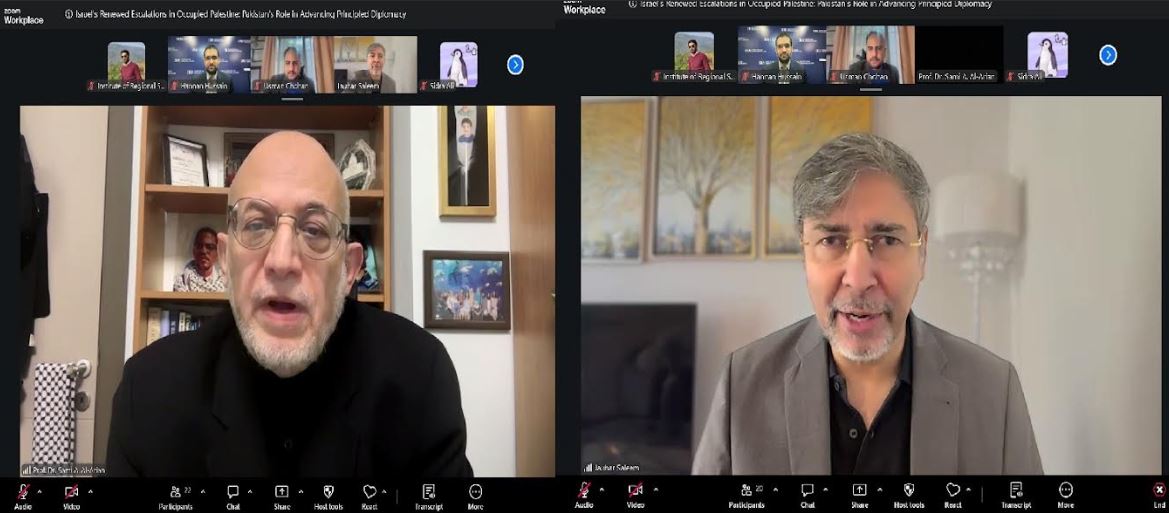
ISLAMABAD, SEP 29: The West Asia Program of the Institute of Regional Studies (IRS) successfully organized an Eminent Speaker Series webinar titled “Israel’s Renewed Escalations in Occupied Palestine: Pakistan’s Role in Advancing Principled Diplomacy”. The session featured Dr. Sami Al-Arian, Director of the Center for Islam and Global Affairs (CIGA), Istanbul Zaim University, as its speaker.
In his introductory remarks, President of the Institute of Regional Studies, Ambassador Jauhar Saleem, stated that Muslim countries have remained committed to peace for decades. Yet, the continued violence against Palestinians demonstrates the failure of the international community to prevent atrocities and protect the Palestinian people. He noted that while international courts and organizations have repeatedly condemned the Israeli attacks, such condemnations have not been sufficient to stop the violence. He emphasized that Pakistan has consistently supported the Palestinian people and their legitimate rights, maintaining its principled position on the Palestinian Question. Ambassador Saleem also highlighted the support extended by countries that have stood with Palestine and emphasized the importance of continued international efforts to uphold the rights, dignity, and aspirations of the Palestinian people.
In his address, Dr. Sami Al-Arian emphasized the need to reconsider the political framework through which the Palestinian Question has been addressed over the past several decades. He argued that the longstanding view to peace processes, negotiations and normalization demonstrates room to account for the historical roots of the conflict. He stressed that the Palestinian Question did not begin in 1967 or on October 7, 2023, but must be understood in the context of the Nakba of 1948, when approximately 700,000 Palestinians were displaced. He further highlighted that more than 7.5 million Palestinians worldwide remain either displaced, or are denied their right to return.
Reflecting on the Oslo Peace Process, Dr. Al-Arian noted that fundamental issues concerning Jerusalem, refugees, settlements, borders and sovereignty remained unresolved. He highlighted the expansion of Israeli settlements, with the settler population increasing from fewer than 125,000 in 1993 to more than 800,000, alongside rising settler violence and the displacement of Palestinian communities in the occupied West Bank. Addressing October 7, he emphasized the importance of understanding the events within the broader context of Gaza’s prolonged blockade, settlement expansion, developments surrounding the Al-Aqsa Mosque, the issue of Palestinian prisoners and regional normalization efforts.
Regarding Pakistan’s role, Dr. Al-Arian highlighted its potential to advance Palestinian rights through principled diplomacy and its relationships with the Muslim world, China, Western countries and the Global South. He encouraged Pakistan to help build a broader diplomatic coalition supporting Palestinian self-determination.
Concluding his address, Dr. Al-Arian called for a political future based on freedom, justice, the right of return, self-determination and equality of Palestinians, envisioning a Palestine where Muslims, Christians and Jews could coexist with equal rights and dignity. The session concluded with an interactive Q&A session focused on the Palestinian Question, Pakistan’s diplomatic role and prospects for a just and sustainable resolution of the conflict.