
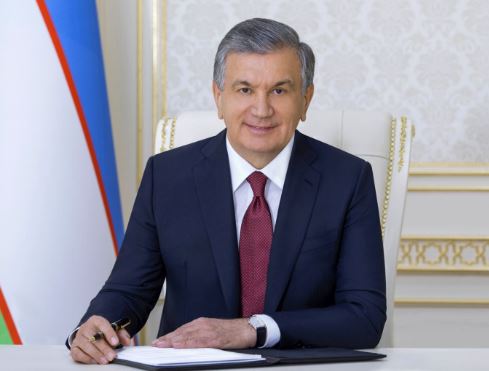
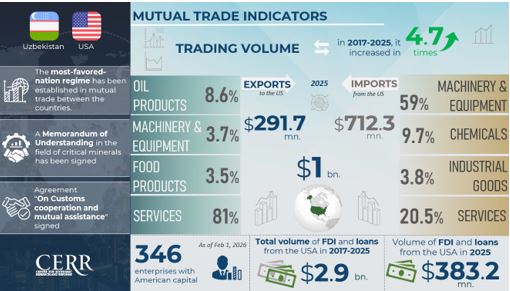
TASHKENT, FEB 18 /DNA/ – At the invitation of the President of the United States, Donald Trump, the President of Uzbekistan, Shavkat Mirziyoyev, will pay a working visit to Washington, D.C. on February 17–19 of this year to participate in the inaugural meeting of the Peace Council. The Center for Economic Research and Reforms (CERR) has prepared an infographic presenting key indicators of trade, economic and investment cooperation between Uzbekistan and the United States over the past 9 years.
History of visits
The President of the Republic of Uzbekistan has visited the United States several times on working visits aimed at expanding bilateral Uzbek-American cooperation, as well as participating in events organized by the United Nations. The first official visit of the Head of our State to the United States took place on May 15–17, 2018 at the invitation of the U.S. President. During the visit, negotiations were held at the White House, the U.S. Congress and the Pentagon, and agreements were signed that marked the beginning of a new stage in the development of Uzbek-American relations.
In subsequent years, dialogue between the two countries developed through bilateral meetings and regional initiatives, including the C5+1 platform.
On September 20–24, 2025, a historic visit of the President of our country to New York took place to participate in events of the юбилейной 80th session of the UN General Assembly. The central event of the visit was the meeting between the Head of our State and U.S. President Donald Trump. The leaders of the two countries agreed to further strengthen Uzbek-American strategic partnership relations and expand practical cooperation.
During his stay in the US, the President of Uzbekistan also held a roundtable with representatives of the U.S. business community, as well as negotiations with executives of a number of leading multinational companies, corporations, investment funds and financial institutions, and took part in a ceremony for the exchange of signed bilateral trade contracts and investment agreements, including in the fields of critical minerals, civil aviation, chemical industry, energy and other priority sectors.
In order to create favorable conditions for the further development of bilateral interstate relations in trade, economic and tourism spheres, by Presidential Decree dated November 3, 2025, a visa-free regime for U.S. citizens entering Uzbekistan was introduced effective January 1, 2026.
Mutual trade indicators
The two countries operate under a Most Favored Nation trade regime.
Over the period 2017–2025, trade turnover between Uzbekistan and the United States increased 4.7-fold, from $215 mln to $1 bn. Exports grew 9.1-fold, from $32.1 mln to $291.7 mln, while imports increased 3.9-fold, from $182.9 mln to $712.3 mln.
The share of the United States in Uzbekistan’s foreign trade over this period rose as follows: in total trade turnover from 0.8% to 1.2%, in exports from 0.3% to 0.9%, and in imports from 1.3% to 1.5%.
In the structure of exports to the United States, the main share is accounted for by services — 81% (programming, financial, information and transport services), as well as petroleum products — 8.6% (aviation kerosene and others). These are followed by machinery and equipment — 3.7%; food products — 3.5% (dried fruits and vegetables, spices, rice and others); industrial goods — 3.3% (aluminum bars and profiles, rhenium metal and others); miscellaneous manufactured articles — 0.9%; chemicals — 0.4%; beverages and tobacco — 0.2%; and non-food raw materials — 0.1%.
In imports from the United States, machinery and equipment dominate — 59% (aircraft, automobiles and their parts, computer units, engines, pumps, machine tools and industrial installations). A significant share is also accounted for by services — 20.5% (financial, licensing, leasing and transport services). These are followed by chemicals — 9.7% (pharmaceuticals, binding agents and cosmetic substances); industrial goods — 3.8% (plastic and ferrous metal products and others); food products — 3.2% (poultry meat and by-products); miscellaneous manufactured articles — 2.2% (devices, instruments, paper products); non-food raw materials — 1.1% (cellulose and others); as well as beverages and tobacco — 0.5%.
Investment cooperation
As of February 1, 2026, there are 346 enterprises with U.S. capital operating in Uzbekistan, which accounts for about 2% of the total number of enterprises with foreign investment. Of these, 146 are joint ventures and 200 are foreign companies with U.S. capital participation.
The volume of foreign direct investment and loans from the United States over the past nine years has increased nearly 64-fold — from $8.6 mln in 2017 to $383.2 mln in 2025.
Overall, in 2017–2025 the cumulative volume of attracted U.S. FDI and loans into Uzbekistan’s economy exceeded $2.9 bn.
Investments were directed primarily into manufacturing industries (metallurgy, production of motor vehicles, beverages and textile products), mining industry, construction, services (real estate operations, education), as well as agriculture.
CERR Public relations and media sector