

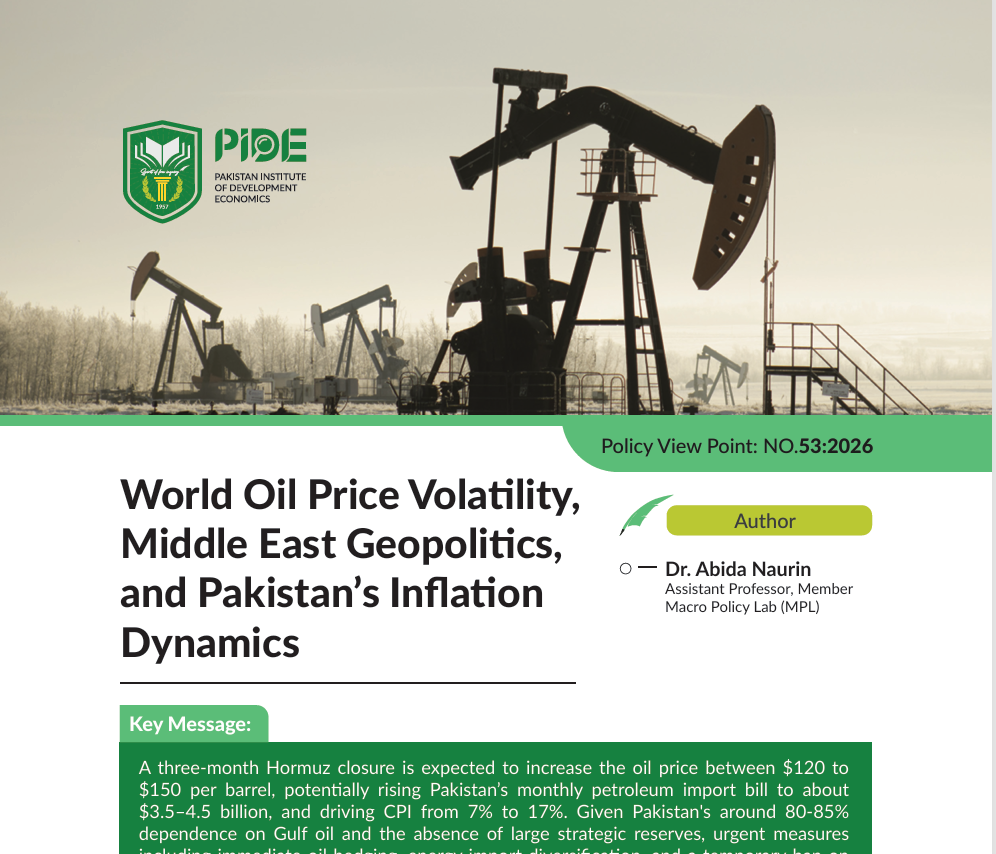
ISLAMABAD: Mar 12 /DNA/: A new Policy Viewpoint released by the Pakistan Institute of Development Economics (PIDE) warns that escalating geopolitical tensions in the Middle East could trigger a sharp increase in global oil prices, posing serious risks for Pakistan’s inflation outlook, external balance, and overall economic stability. The study, authored by Dr. Abida Naurin, Assistant Professor and member of the Macro Policy Lab at PIDE, highlights Pakistan’s structural vulnerability due to its heavy dependence on imported petroleum and limited strategic reserves.
The report notes that rising geopolitical risks surrounding the Strait of Hormuz, a critical maritime corridor that carries about 20 percent of global seaborne oil trade, have already pushed crude oil prices upward in early 2026. As tensions linked to the US–Israel–Iran conflict intensify, the resulting uncertainty has added a significant geopolitical risk premium to global energy markets, increasing volatility in oil prices.
Pakistan remains particularly exposed to these developments because petroleum products account for nearly 30 percent of its total imports. According to the analysis, every $10 increase in global oil prices could raise Pakistan’s annual petroleum import bill by approximately $1.8–2.0 billion, while also transmitting inflationary pressures across the economy through higher transport, energy, and food costs.
The study warns that in a worst-case scenario—such as a three-month disruption in the Strait of Hormuz—global oil prices could surge to between $120 and $150 per barrel. Under such circumstances, Pakistan’s monthly petroleum import bill could rise sharply to between $3.5 and $4.5 billion, while consumer inflation could climb from around 7 percent to as high as 15–17 percent.
The research further highlights Pakistan’s structural exposure to energy shocks. The country imports nearly 80–85 percent of its petroleum requirements, with most shipments passing through a single maritime route via the Strait of Hormuz before reaching Karachi and Port Qasim. With petroleum reserves covering only about 10–14 days of consumption, Pakistan has limited buffers to absorb supply disruptions compared to regional peers such as India, which maintains significantly larger strategic reserves.
The Policy Viewpoint emphasizes that even moderate increases in oil prices can widen Pakistan’s current account deficit and intensify macroeconomic pressures. Rising shipping insurance, freight costs, and supply delays could further raise import expenditures and weaken foreign exchange reserves, increasing the risk of broader economic instability.
To mitigate these risks, the study recommends a combination of immediate and long-term policy measures. In the short term, it calls for strengthened monitoring of fuel stocks, diversification of import routes and suppliers, and the exploration of oil hedging strategies to protect against price volatility. In the medium to long term, the report stresses the importance of expanding strategic petroleum reserves, diversifying energy imports, and accelerating investments in renewable energy and energy efficiency to reduce Pakistan’s vulnerability to global oil shocks.
The study concludes that timely and coordinated policy action can help Pakistan navigate global energy volatility while strengthening its long-term energy security and macroeconomic resilience. With proactive reforms and diversification strategies, Pakistan can transform current vulnerabilities into an opportunity to build a more stable and sustainable energy framework for the future.















 warns that escalating)