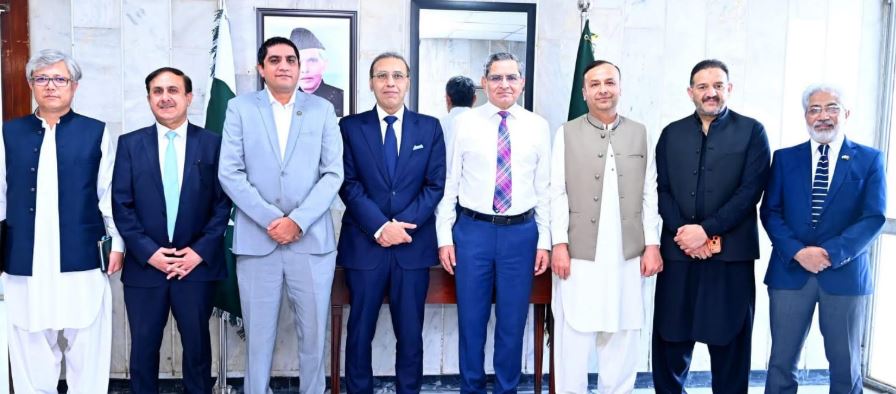
Rawalpindi: /DNA/ – President Rawalpindi Chamber of Commerce and Industry (RCCI), Usman Shaukat, who also serves as Chairman PPMA North, held a productive meeting with Dr. Najeeb Memon, Director General, Tax Policy Office, in Islamabad to discuss key budget proposals and challenges faced by the business community.
The RCCI delegation included Sardar Saqib Naseem, President Furniture Dealers Association Rawalpindi & RCSTI; Bilal Javaid, Vice President Rawalpindi Furniture Association and Executive Member RCCI; and Zahid Hussain, Chairman Pakistan Furniture Association.
President Usman Shaukat appreciated the proactive engagement of the Tax Policy Office and emphasized the importance of incorporating stakeholders’ input in the upcoming federal budget. He noted that sustained consultation with the private sector is vital for developing practical, growth-oriented economic policies. He highlighted key concerns including ease of doing business, simplification of tax return procedures, and rationalization of tax rates to improve compliance and broaden the tax base.
The meeting featured detailed discussions on sector-specific challenges, particularly in pharmaceuticals and health services. Participants stressed the need for targeted policy reforms to unlock export potential and enhance domestic production capacity.
RCCI presented key recommendations, including tax rationalization measures and the removal of burdensome “further tax,” specifically the additional 4% levy on top of the standard 18% sales tax. It was observed that such measures discourage documentation and may contribute to informal practices, including the misuse of invoicing systems.
The delegation also acknowledged the Federal Board of Revenue’s (FBR) initiatives toward digitalization and automation, including AI-based production monitoring systems. While welcoming these reforms, RCCI emphasized the need for phased implementation, capacity building, and facilitation for businesses.
On the export front, representatives shared proposals to enhance pharmaceutical exports to $3–5 billion, particularly targeting emerging markets through regulatory facilitation and incentives. The importance of supporting local manufacturing, easing import regulations for raw materials, and promoting quality-driven production was also highlighted.
Additionally, the meeting underscored the potential of Pakistan’s $3 billion furniture industry, driven by skilled SMEs in Gujrat, Chiniot, Peshawar, and Rawalpindi. Key challenges such as dependence on imported wood, outdated machinery, and limited global branding were discussed.
Dr. Najeeb Memon appreciated RCCI’s constructive input and assured that the recommendations would be carefully considered in the budget formulation process, reaffirming the government’s commitment to a business-friendly and sustainable economic environment.