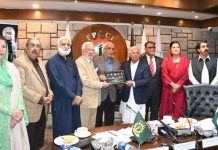
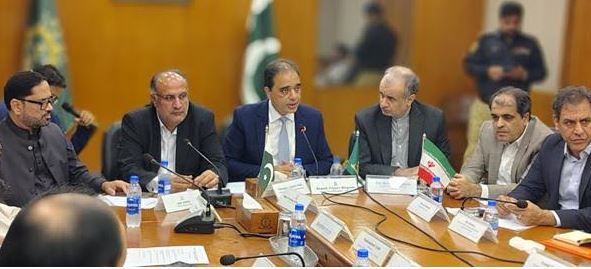
KARACHI, MAY 12 /DNA/ – Atif Ikram Sheikh, President of the Federation of Pakistan Chambers of Commerce & Industry (FPCCI), has expressed his objective optimism for rapid increase in bilateral trade volumes between Pakistan and Iran. It is pertinent to note that today FPCCI hosted a prominent Iranian business and government delegation at the Federation House – laying the groundwork for a massive expansion in cross-border economic ties.
Mr. Atif Ikram Sheikh apprised that, following extensive B2B meetings and policy discussions, FPCCI leadership confidently projected that scaling the bilateral trade volume between Pakistan and Iran to $10 billion within the next few years is highly achievable through strategic alignment and the resolution of technical barriers to trade.
The Iranian delegation consisted of H. E. Mr. Hasani, Deputy Governor for Economic Affairs of Sistan and Baluchestan Province; H. E. Mr. Akbar Eissa Zadeh, Consul General of Iran in Karachi; Mr. Mohammad Saeed Arbabi, CEO of the Chabahar Free Zone and other prominent business personalities.
Mr. Saquib Fayyaz Magoon, SVP FPCCI, informed that the dialogue focused heavily on unlocking immediate commercial opportunities in core sectors; including, logistics, transportation, maritime linkages, rice and meat exports.
Mr. Saquib Fayyaz Magoon, SVP FPCCI, highlighted the operational mechanisms required to reach these trade targets. Unlocking this $10 billion potential requires formalizing and fully operationalizing our barter and regional trade mechanisms.
Mr. Abdul Mohamin Khan, VP & Regional Chairman Sindh, FPCCI, has said that by fostering direct, robust B2B linkages and establishing secure, alternative payment channels, we can overcome existing bottlenecks and significantly reduce the cost of doing business between our two nations.
Mr. Nasir Khan, VP FPCCI, addressed the critical infrastructure required for this trade volume and pointed toward maritime and logistical synergy. We must pivot our perspective and view the ports of Gwadar and Chabahar as complementary assets rather than competitors. By integrating our logistics, transportation and maritime strategies, we can transform this region into a premier global transit hub – facilitating seamless cargo movement and joint industrial ventures.
Mr. Asif Sakhi focused on the immediate export potential and underscored the importance of agricultural and food sectors. Pakistan possesses an immense, untapped capacity to meet Iran’s growing food security needs. Our premium rice and halal meat sectors are fully equipped to capture a massive share of the Iranian market. To realize this, we urge authorities on both sides to drastically simplify customs procedures, modernize border management and ensure uninterrupted cold-chain logistics, he added.
The visit concluded with a consensus on establishing dedicated follow-up on the B2B linkages. FPCCI reiterated its commitment to aggressively pursuing the $10 billion trade target through sustained economic diplomacy and private-sector advocacy.