NEW YORK, MAY 16: Israel and the United States are carrying out their most intense preparations yet to renew attacks on Iran, possibly as soon as next week, two Middle Eastern officials told The New York Times on Friday.
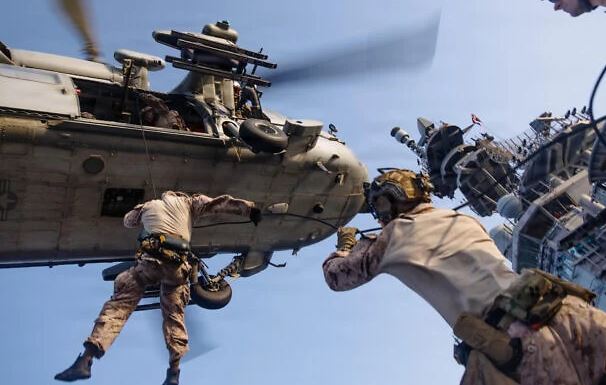
According to US officials cited by the newspaper, options for renewed operations in Iran include launching a more intense bombing campaign against military and infrastructure sites; conquering Iran’s key oil export hub of Kharg Island in the Persian Gulf; and putting commandos on the mainland to extract nuclear material buried under the rubble.
Extracting the highly enriched uranium would risk several casualties and require thousands of supporting forces to create a perimeter around an area of operation and likely engage with Iranian ground troops, the Times cited military officials as saying.
Promoted: Jewish Crossroads, Jon Goldberg-Polin
Keep Watching
A senior Israeli official was also quoted by Channel 12 as saying Israel was preparing for imminent war and waiting for US President Donald Trump to decide how to proceed in negotiations with Iran to end the conflict.
“The Americans understand that negotiations with Iran are going nowhere,” the unnamed official claimed.
“We’re preparing for days to weeks of fighting and waiting for Trump’s final decision. We’ll know more in 24 hours,” the official said. It was unclear why the official cited a 24 hour window.
US President Donald Trump speaks to reporters aboard Air Force One as he returns from a trip to Beijing, China, on May 15, 2026. (AP Photo/Mark Schiefelbein)
Pakistani-mediated negotiations, supported by China, have failed to secure a settlement between the US and Iran, with the talks faltering over Iran’s nuclear program and the post-war control of the Strait of Hormuz.
On Friday, departing after a two-day visit to China, Trump said he would accept a 20-year suspension of Iran’s uranium enrichment program if Tehran gave a “real” guarantee, in an apparent shift from his earlier demand that Iran pledge to permanently halt enrichment.
Advertisement
While Iran, whose leaders are sworn to Israel’s destruction, denies seeking nuclear arms, it has amassed uranium enriched to near weapons-grade levels with no peaceful application.
Iran’s stockpile of about 440 kilograms (970 pounds) of highly enriched uranium — enough for about ten nuclear warheads — is thought to have been buried following US strikes on key Iranian nuclear facilities during the 12-day Israel-Iran war in June last year.
Iraq oil exports via Hormuz plummet; Iran said suspected of US gas station hack
Israel and the US launched the war on Iran on February 28 in a bid to destabilize the regime and destroy its ballistic missile and nuclear programs.
Iran responded with missile and drone strikes across the region and by imposing a blockade on the Strait of Hormuz, choking off about a fifth of the world’s oil shipments.
The war entered a truce on April 8, during which the US imposed its own blockade on Iran-linked shipping and briefly sought to guide trapped vessels through the waterway.
Supply chain disruptions have triggered a sharp rise in energy prices worldwide.
Advertisement
Iraq’s new oil minister, Basim Mohammed, said at a press conference on Saturday that his country exported 10 million barrels via the strait in April, down from about 93 million barrels monthly before the Iran war.
A woman waves an Iranian flag in front of an anti-US billboard referring to US President Donald Trump and the Strait of Hormuz at Valiasr Square in Tehran, Iran, on May 5, 2026. (AFP)
The exports previously accounted for some 90 percent of the Iraqi government’s budget revenues.
Meanwhile, US officials suspect Iran is behind a hack of systems that monitor the levels of available fuel in storage tanks that supply gas stations in some states, CNN reported Friday, citing sources briefed on the investigation.
The report said the hackers took advantage of online systems that weren’t protected by passwords. No physical damage was done to the systems, and the hackers changed the display system showing the fuel level, rather than the actual amount of fuel itself, according to the report.
Tehran was suspected because it had a history of trying to hack the systems, but it’s possible the culprits will never be identified, the sources said.
It was unclear why the systems did not have more robust protections if they had been previously targeted. CNN said there was no comment from the FBI or US Cybersecurity and Infrastructure Security Agency.