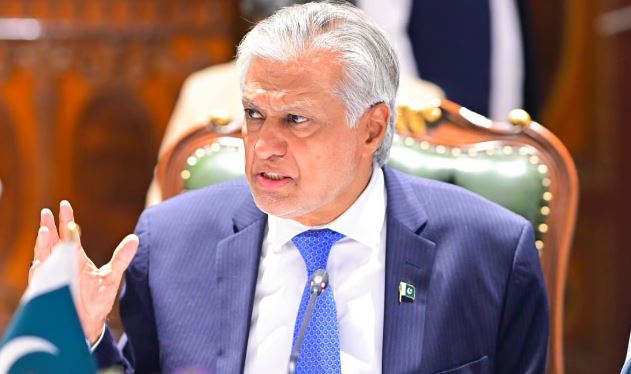
UNITED NATIONS / ISLAMABAD, 26 May /DNA/ – Senator Mohammad Ishaq Dar, Deputy Prime Minister and Foreign Minister of Pakistan, today warned that the greatest crisis facing the international system is not the absence of principles, but their selective application, as he addressed the UN Security Council Open Debate on “Maintenance of International Peace and Security: Upholding the Purposes and Principles of the UN Charter and Strengthening the UN-centered International System.”
Speaking at a debate convened by China’s Foreign Minister Wang Yi during its Security Council presidency, Deputy PM Dar commended China’s steadfast commitment to multilateralism, stating that at a time of deepening divisions and growing disregard for international law, China’s call for a strong UN-centered system was “most timely and vital.” He also thanked UN Secretary-General António Guterres for his principled leadership.
Senator Dar underscored that the UN Charter is “not merely a legal instrument” but the moral foundation of the international order, affirming sovereign equality, prohibiting the threat or use of force, and mandating the peaceful settlement of disputes. For Pakistan, he said, these principles are “sacrosanct” and form the basis of its foreign policy and contributions to global peacekeeping.
He recalled that Pakistan successfully piloted UN Security Council Resolution 2788 in July 2025 on strengthening mechanisms for the peaceful settlement of disputes, reaffirming that “diplomacy is not weakness; dialogue is not concession; peaceful settlement is not an option of last resort.”
Highlighting Pakistan’s proactive diplomacy, the Deputy Prime Minister revealed that during his visit to Beijing on 31 March 2026 at the invitation of Foreign Minister Wang Yi, Pakistan and China jointly announced the ‘Five Point Initiative for Restoring Peace and Stability in the Gulf and Middle East Region.’ He noted that Pakistan has exerted sincere efforts to facilitate a durable solution, thanking parties for their confidence in Pakistan and partners including China, Saudi Arabia, Egypt, Türkiye, and Qatar for their support. “The entire world is watching – we must succeed in the interest of regional and global peace and security,” he declared.
Senator Dar reminded the Council that for nearly eight decades, the Jammu and Kashmir dispute has remained unresolved despite clear Security Council resolutions promising self-determination. He warned that durable peace in South Asia cannot coexist with attempts to hold the Indus Waters Treaty in abeyance, stressing: “Water must never be weaponized; treaties must be honoured.”
On Palestine, he called the situation in Gaza and the West Bank “increasingly volatile,” and urged sustained momentum behind the New York Conference on the Two-State solution and the Gaza Peace Plan presented by President Donald Trump, endorsed by Security Council Resolution 2803. Pakistan reaffirmed unwavering support for a viable, contiguous Palestinian state based on pre-1967 borders with Al-Quds Al-Sharif as its capital.
In a sharp critique, the Deputy Prime Minister stated: “The crisis lies in selective application. When sovereignty is defended in one case but disregarded in another, the Charter is weakened. When occupation is condemned in one region but tolerated in another, justice is diminished. When powerful States act outside the law, smaller States are left to wonder whether the Charter protects all nations equally.”
Rejecting any creation of new permanent seats, Senator Dar called for comprehensive reform of the Security Council based on an increase in elected non-permanent seats allocated to regions, alongside improved working methods. “Reform must not enlarge privilege… A reformed Council must reflect the collective interests of the wider membership, particularly developing countries,” he said.
Concluding, the Deputy Prime Minister emphasized that peace is “not merely the silence of guns” but the presence of justice, protection of civilians, dignity, development, and equal rights. He reaffirmed Pakistan’s readiness to work with all Council members to uphold the Charter, strengthen the UN-centered system, and build an equitable international order “where power is restrained by law, disputes are resolved through dialogue, and peace is secured through justice.”