By our correspondent
ISLAMABAD: FIFA and the Asian Football Confederation (AFC) have called for urgent revisions to the Pakistan Football Federation (PFF) Constitution, stressing that the federation must align its statutes with international governance standards while warning that any third-party interference in football affairs will not be tolerated.
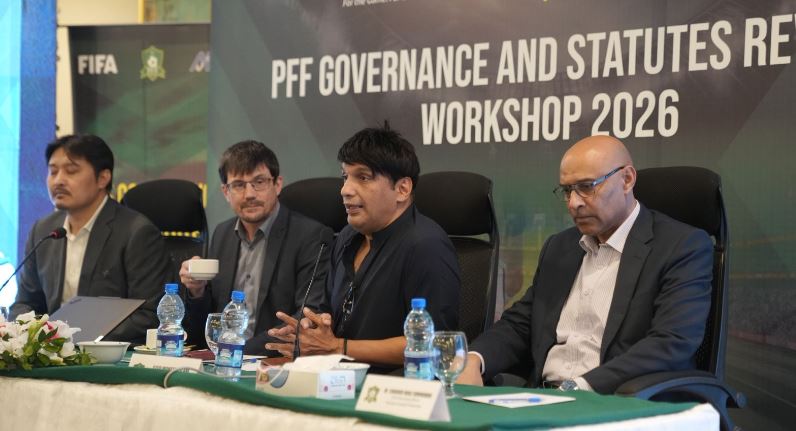
This outcome emerged on the first day of the Governance and Statutes Revision Workshop organized by the Pakistan Football Federation, where FIFA’s Head of Member Associations Governance, Rolf Tanner, and AFC Senior Manager of the South Asia Unit, Sonam Jigmi, addressed members of the PFF Congress.
The FIFA and AFC officials underlined the importance of safeguarding the autonomy of the federation, making it clear that external interference in the affairs of the PFF is unacceptable under international football regulations.
The PFF Constitution was last comprehensively revised in 2014, although some clauses were amended ahead of last year’s Elective Congress, which was conducted under the FIFA-appointed Normalisation Committee.
During the workshop, members of the PFF Congress were briefed on key principles of good governance. Tanner and Jigmi emphasized the separation of powers between the legislative, executive and judicial bodies of the federation, describing it as a cornerstone of transparency and accountability.
The discussions also focused on conflict-of-interest regulations, gender equality, transparency, competence-based governance and institutional accountability. FIFA and AFC officials stressed that constitutional reform is essential to creating a modern and stable football administration structure in Pakistan.
“The distinction of powers ensures effective checks and balances and significantly reduces the risk of corruption,” Tanner said.
He added that revision of the 2014 PFF Constitution is an urgent requirement set by FIFA and the AFC to ensure long-term stability and sustainable development within Pakistan football.
“FIFA and AFC directed that the PFF Constitution be revised within one year of the elections, and this workshop is an important step towards ensuring that the process is completed as soon as possible,” he said.
Highlighting the direct link between governance and sporting success, Tanner added that stronger institutions ultimately lead to better performances on the field.
“You are not going to progress at a sporting level with an archaic federation. Our ultimate objective is to create an environment where football can develop, flourish and be played at the highest level,” he remarked.
AFC official Sonam Jigmi assured Congress members that the constitutional review process would be transparent, inclusive and consultation-based. He also warned that failure to comply with FIFA and AFC regulations could have serious consequences.
“A federation that does not comply with FIFA and AFC obligations risks losing its rights and privileges as a member association,” Jigmi said.
PFF President Syed Mohsen Gilani welcomed the reform process, describing governance reforms as essential for the future of football in Pakistan.
“The revision of the statutes has remained pending for more than a decade while other federations have moved far ahead. We must complete this process now and lay the foundations for a stronger and more progressive football federation,” Gilani said.
The workshop marks a significant milestone in Pakistan football’s reform agenda and is expected to pave the way for comprehensive constitutional amendments aimed at strengthening governance, ensuring institutional independence and promoting the long-term growth of the game in the country.