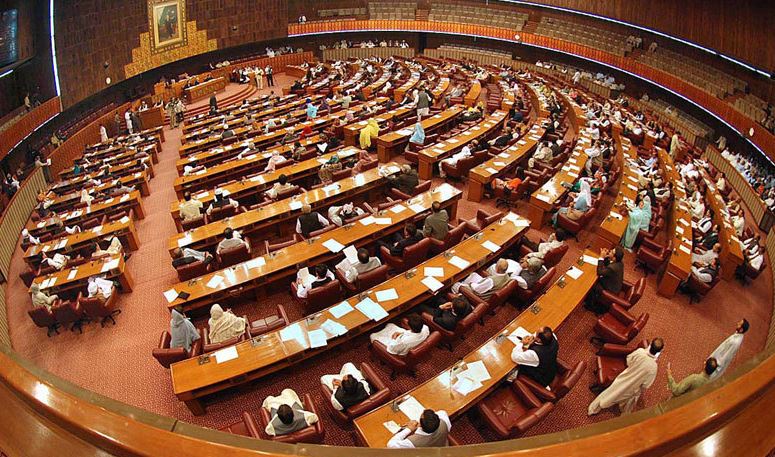
ISLAMABAD, JUN 21: The National Assembly on Sunday approved six demands for grants related to the energy and power sectors for the next financial year worth Rs 661,265,815,000 (Rs 661.27 billion approx.), while rejecting 116 cut motions moved by opposition lawmakers.
The demands for grants were presented in the House by Minister for Finance and Revenue Senator Muhammad Aurangzeb.
The house approved allocations, Rs 578,837,216,000 were granted for the Power Division, while Rs 1,111,666,000 were approved for the Petroleum Division. An amount of Rs 1,201,001,000 was sanctioned for the Geological Survey of Pakistan.
For development expenditures, the House approved Rs 3,196,630,000 for the Development Expenditure of the Power Division. In addition, Rs 311,800,000 were allocated for capital outlay on the Petroleum Division.
The National Assembly also approved Rs 76,607,502,000 for External Development Loans and Advances of the Power Division.
Opposition members criticised the allocations during the proceedings, but their cut motions were rejected by the House.
Responding to points raised by lawmakers during the National Assembly session, Minister for Power Division Sardar Awais Ahmad Khan Leghari rejected claims made by opposition members, saying the figures presented by them did not reflect the actual situation in the power sector.
He said most of the criticism from the opposition related to consumer services, complaint redressal and customer facilitation, while relatively no concerns were raised about the power infrastructure itself.
He said the fiscal burden of the power sector had declined from Rs1,287 billion in FY2024-25 to Rs893 billion last year and was expected to fall further to Rs700 billion during the current fiscal year.
“The government has succeeded in easing the burden on taxpayers by Rs587 billion within two years through prudent management and reforms in the power sector,” he told the House.
The minister said the circular debt of the power sector stood at around Rs2.4 trillion when the present government assumed office. He added that the government had reduced the circular debt stock by Rs780 billion through administrative and financial measures.
Highlighting improvements in distribution companies (DISCOs), Leghari said annual losses had declined from Rs591 billion to Rs335 billion over the last two years. He said reforms had helped improve recoveries and reduce inefficiencies.
Referring to negotiations with Independent Power Producers (IPPs), he said the government had successfully revised several agreements, which would save consumers nearly Rs3.5 trillion in future liabilities.
The minister said reforms had also been implemented in power-generation companies (Gencos), where employees were integrated into distribution companies while their jobs were protected and operational efficiency improved.
He added that around 76 percent of Pakistan’s electricity generation was now based on indigenous energy resources, reducing reliance on imported fuels and limiting the impact of global energy price fluctuations.
Leghari said the government was promoting competitive electricity markets, battery energy storage systems and greater private sector participation in the energy sector.
Defending the government’s privatization policy, he said both profitable and loss-making DISCOs would be considered for privatization to improve efficiency and service delivery.
On load management, he said economic load-shedding was currently being carried out on around 3,500 of the country’s 14,500 feeders due to high losses and low recoveries.
However, he said the government had launched a Rs50 billion programme to gradually eliminate economic load-shedding by June next year. Under the initiative, electricity supply would be monitored at transformer level to ensure that paying consumers were not affected by defaulters in their areas.
The minister reiterated the government’s commitment to reducing losses, improving consumer services and ensuring a financially sustainable power sector capable of providing affordable and reliable electricity across the country.