
– Syeda Zainab Gilani
Walking a Friendship Across Generations: Reflections from Xinjiang
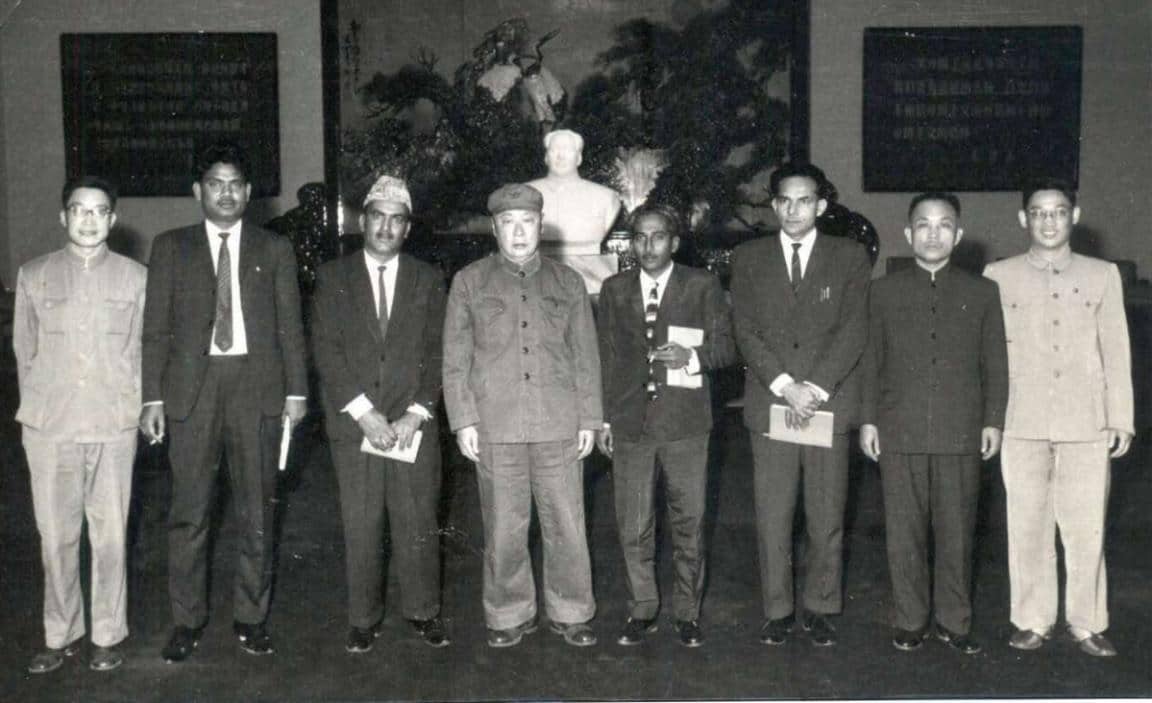
Some journeys do not begin with the traveller. They begin decades earlier, carried quietly across generations until someone finally walks them into the present. For me, a recent delegation visit to Xinjiang with the Pakistan-China Friendship Association was not merely a diplomatic mission, but the continuation of a seven-decade family legacy. My family’s connection with China spans more than seven decades. In 1966, my grandfather, S. M. Hassan Gilani, travelled as part of a Pakistani press delegation and met senior Chinese leaders, including Vice-Premier and Foreign Minister Chen Yi. A photograph from that visit, preserved by our family, marks an early chapter in Pakistan-China relations, when the foundations of mutual trust were still being built.

With Madam Zumrat Obul, Chairperson of the Standing Committee of the Xinjiang Uyghur Autonomous Region People’s Congress
Years later, my late father, Syed Ali Nawaz Gilani, carried that legacy forward as General Secretary of the Pakistan-China Friendship Association, Khyber Pakhtunkhwa chapter. He devoted much of his life to strengthening people-to-people ties through cultural exchange and mutual understanding. Our delegation, led by Khyber Pakhtunkhwa Assembly Speaker Babar Saleem Swati, followed a rigorous programme of official, cultural, and institutional engagements in Urumqi.Honestly, initially I viewed this journey as a cultural and diplomatic visit. It soon became clear, however, that I was participating in a story much larger than myself one that had begun long before I was born.
Yet amid the formal programme, what stood out most was not protocol, but human connection. One of our earliest visits was to Guyuanxiang Community, where education, recreation, and community life are thoughtfully integrated. The experience reinforced a simple truth that strong societies are built not only through infrastructure, but by investing in people and nurturing human potential. That same warmth extended to the Xinjiang International Grand Bazaar. The bustling markets and the familiar sight of naan, a staple cherished in both Xinjiang and Peshawar, offered a quiet reminder that the 41 years sister-city relationship between Urumqi and Peshawar is reflected not only in official agreements, but also in the shared rhythms of everyday life.
Rounding out the itinerary, our delegation visited institutions showcasing public administration and urban planning. As a student of law and governance, I found these visits particularly insightful, highlighting the value of long-term planning, institutional efficiency, and integrated public service delivery.
During our stay in Urumqi, I had the opportunity to meet Madam Zumrat Obul, Chairwoman of the Standing Committee of the Xinjiang Uyghur Autonomous Region People’s Congress, whose warmth and openness left a lasting impression. When I shared my family’s longstanding connection with China from my grandfather’s 1966 visit to my father’s lifelong efforts to strengthen Pakistan-China friendship she responded with genuine appreciation, underscoring that enduring diplomacy is often rooted deep in personal relationships.
That same spirit was reflected in the celebration marking the 41st anniversary of the Urumqi–Peshawar sister-city relationship. We were warmly received by Yakup Paydulla, Deputy Secretary of the CPC Urumqi Committee and Mayor of Urumqi, alongside Mirgul Tursun, Chairperson of the Standing Committee of the Urumqi Municipal People’s Congress, and other senior officials. As speeches were exchanged and decades of cooperation were reaffirmed, what remained most memorable was the sincerity of the welcome extended to our delegation.
That genuine hospitality followed us to Kashgar, a historic Silk Road city where the visit assumed an even more personal meaning. Upon arrival, I discovered that I was staying in the very hotel where my late father had stayed during his earlier visits. It was a small detail, yet it transformed the journey. I was no longer simply recalling his stories; I was walking in his footsteps. That sense of continuity deepened when a Foreign Affairs Office official remarked that sister-city relationships, particularly between Kashgar and Abbottabad, had been shaped in part by the long-standing efforts of individuals like my father in 2007. It was a brief observation, but one that stayed with me. In that moment, the distance between generations seemed to disappear.
That reflection remained with me as I explored Kashgar Ancient City. Its narrow streets, artisan workshops, music, and daily rhythms revealed a place where history is not preserved behind glass, but lived each day. Walking through its lanes, I reflected on my grandfather’s early engagement with China, my father’s lifelong dedication, and my own place in that continuing story.
By the end of the trip, I realized I would remember far more than official visits or formal engagements. I would remember the children singing in a classroom, candid conversations with local hosts, officials who welcomed us as genuine friends, and the realization that this cross-generational story is still unfolding. While diplomacy, trade, and strategic cooperation often define Pakistan-China relations, Xinjiang reminded me that the partnership’s enduring strength rests on sustained human connection. My family’s journey with China began more than seventy years ago, and carrying that legacy forward was a profound privilege.
Everywhere we went, the familiar presence of naan served as a simple but a grounding symbol, a quiet reminder that the deepest and most enduring bonds between nations are woven into everyday life long before they are ever recorded in history.
Syeda Zainab Gilani is a member of the Pakistan-China Friendship Association, Khyber Pakhtunkhwa Chapter, representing the legacy of her late father, Syed Ali Nawaz Gilani, former General Secretary of the Association. She holds an LLB from the University of London and an LLM in Oil, Gas and Renewable Energy Law from Scotland, United Kingdom. She is also a former UN Women UK delegate to CSW68.