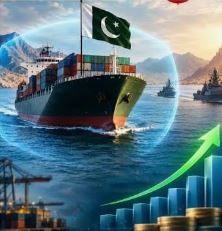
UNITED NATIONS, Oct 30 (DNA)::Pakistan Thursday strongly warned that intensifying global conflicts must not be allowed to paralyze international maritime commerce, stressing that global shipping cannot become a “casualty of conflict and strife.”
Speaking at a high-level United Nations Security Council debate, Pakistan’s Acting Permanent Representative, Ambassador Usman Jadoon, stressed that international waterways must remain resilient drivers of the global economy.
The debate on ‘Emerging Technologies and Maritime Security: Implications for Peace and Security’ was convened by Greece, which holds the presidency of the 15-member Council for the month of October.
Highlighting how rapidly regional choke points can trigger widespread energy and food crises, Ambassador Jadoon called for a legally grounded, cooperative framework to guarantee safe passage, secure critical marine infrastructure, and shield vulnerable developing economies from the cascading shocks of geopolitical instability.
In this context, the Pakistani envoy strongly condemned the Houthi militia’s “nefarious designs” to weaponize Bab-Al-Mandab, attacking merchant shipping and seafarers navigating the strait, asserting that these attacks undermine maritime security and threaten peace and development of regional countries, especially that of Saudi Arabia, which has faced the group’s “blatant aggression”.
“Pakistan reaffirms its unwavering support for the sovereignty and territorial integrity of the Kingdom and stands in complete solidarity with its leadership and people.”
Ambassador Jadoon reiterated Pakistan’s unwavering support for the sovereignty and territorial integrity of neighbouring and brotherly countries in the region bearing the collateral brunt of the maritime crises.
Pakistan, he said, maintained that addressing multifaceted maritime challenges—ranging from piracy and tech-driven conflicts to climate-induced ocean risks—requires collective, coordinated action firmly anchored in international law, dialogue, and preventive diplomacy.
“The challenge before us,” Ambassador Jadoon said, “is to seek ways to harness emerging technologies and AI for reinforcing maritime security, and to plug loopholes for its misuse.’
“An affordable and responsible use of emerging technologies and AI merits evolving an inclusive regulatory framework in a universal setting, anchored under the UN auspices coupled with capacity-building programmes for the Global South.”
Pointing out that the United Nations Convention on the Law of the Sea (UNCLOS) has served as the cornerstone of international maritime order,” he said that the legal order established by it “must be protected and promoted universally.”
“As one of the littoral states of the Indian Ocean with overwhelming reliance on sea-borne trade, Pakistan attaches paramount importance to maritime safety and security,” he said.
Opening the debate, Earle Courtenay Rattray, the UN Secretary-General’s Chef de Cabinet, said emerging technologies are reshaping maritime security, creating new risks and opportunities.
Non-state actors have already shown both the capability and intent to use these tools in asymmetric ways, he warned, noting that AI is driving this shift.
The risk of error, miscalculation and unintended escalation posed by the growing speed and autonomy of technology systems ultimately have human consequences.
“Our starting point therefore must be human agency. Technology must serve humanity, not the other way around”, he stressed.
Seafarers and affected communities must remain at the center of all response.
“The Charter of the United Nations, the UNCLOS, International Maritime Organization instruments and other applicable international law provide the foundation for our response”, he said.
The international community must connect science, technology and capacity – providing the evidence base needed to evaluate capabilities, risks and opportunities.
For its part, the Council can help connect evidence to policy, policy to capacity and innovation to establish international norms, and to encourage stronger cooperation among States, international and regional organizations, industry, the scientific community and civil society.