ISLAMABAD, SEP 7 /DNA/ – The National Academy of Higher Education (NAHE), Higher Education Commission (HEC) Pakistan, has concluded a three-day Tier-I Faculty Training Programme on Artificial Intelligence (AI) for Lecturers and Assistant Professors serving in public sector higher education institutions (HEIs).
The programme titled “AI Literacy for Educators: Building AI-Ready Institutions,” aims to strengthen faculty capacity to understand, critically evaluate, and responsibly integrate AI into teaching, learning, research, assessment, and academic practice.
NAHE has so far trained around 400 faculty members of universities, including 332 in cohort-I and nearly 64 in cohort-II. The programme has been specifically designed as a comprehensive professional development intervention, combining conceptual understanding, practical hands-on learning, critical reflection, and application of AI in diverse academic contexts.
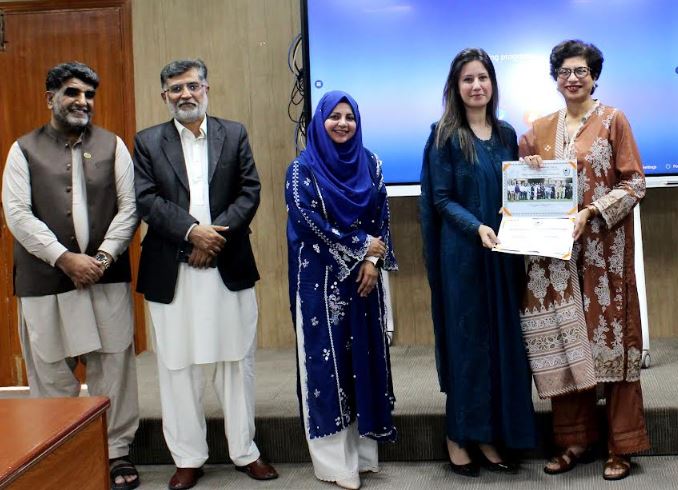
Managing Director NAHE (HEC) Dr. Noor Amna Malik was the chief guest at the opening and closing ceremonies, attended by members of the NAHE team, resource faculty, and participating faculty members.
Addressing the participants, Dr. Noor Amna Malik highlighted the importance of ethical use of AI in higher education. She emphasised that AI is rapidly changing the ways in which knowledge is created, taught, assessed, researched, and applied.
She underscored the need for faculty members to safeguard academic integrity, critically evaluate AI outputs, and protect privacy and intellectual property. Highlighting the importance of developing AI-ready institutions and noting that meaningful AI integration requires capable faculty she asked for developing institutional preparedness, appropriate governance mechanisms, ethical safeguards, and continuous professional development.
The programme focuses on developing among the participants the foundational and applied understanding of Artificial Intelligence, Machine Learning, Deep Learning, Large Language Models, and Generative AI, and their relevance to teaching, learning, research, and assessment.
It also examines discipline-specific applications of AI, including emerging applications in healthcare, business, banking, communication, creativity, data analytics, research, and education. This interdisciplinary component enables participants to consider the relevance and appropriate application of AI within their respective academic disciplines.=DNA