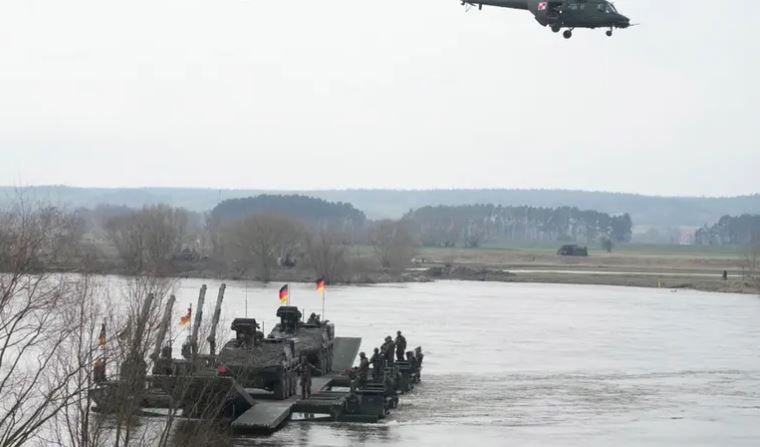
WASHINGTON, MAY 15: The Pentagon has canceled plans to deploy 4,000 US-based troops to Poland, two US officials said, a surprise decision that renews questions about President Donald Trump’s expected troop cuts in Europe. Two weeks ago the Pentagon announced it was withdrawing 5,000 troops from NATO ally Germany, in part due to a widening rift over the Iran war between Trump and Europe.
General Christopher LaNeve, the Army’s acting chief of staff, confirmed the decision during testimony on Friday before the House Armed Services Committee. But he did little to explain it, besides saying “it made the most sense for that brigade to not do its deployment in theater.”
Joe Courtney, a Democratic lawmaker, told LaNeve the decision sent a “horrible message” about Trump’s commitment to Europe.
“Frankly, it’s not just our adversaries that are paying attention. It’s our allies,” Courtney said.
One US official, who spoke to Reuters on condition of anonymity, suggested the Poland decision was part of a near-term solution to ultimately allow for the previously announced drawdown in Germany, which hosts 35,000 US forces. That would suggest the troops that were meant to rotate into Poland might instead come from elsewhere.
Polish Prime Minister Donald Tusk said he had received assurances that Poland’s security would not be impacted by any decisions on the US troop presence.
“I received assurances, and this is also important to me, that these decisions are of a logistical nature and will not directly affect deterrence capabilities and our security,” he told a news conference on Friday.
The US has been reviewing its troop presence in Europe and has long been expected to scale it back following demands from Trump that NATO take a larger role in the defense of Europe. The Pentagon has not yet detailed how it envisions future troop laydowns across the continent.
Even as lawmakers expressed exasperation and confusion over the Poland decision, the Pentagon said it followed “a comprehensive, multilayered process.”
“This was not an unexpected, last-minute decision, and it would be false to report it as such,” Pentagon spokesperson Joel Valdez said.
Trump’s anger over Iran
Trump has also been angered that European allies did not join the US war against Iran, and sparred with German Chancellor Friedrich Merz, who last month said the Iranians were humiliating the US in negotiations.
Senator Jeanne Shaheen, a Democrat who sits on the Senate Armed Services Committee, told reporters the Poland decision appeared to be a surprise.
“As far as I know, we weren’t notified about it,” she told reporters.
When the Germany withdrawal was announced, a senior US official said it would bring US troop levels in Europe back to roughly pre-2022 levels, before Russia’s invasion of Ukraine triggered a buildup by then President Joe Biden.
The latest decisions to withdraw troops also came amid increasing pressure from Washington on European countries to raise defense spending, and accusations that reliance on US forces had allowed them to neglect their own militaries. Reuters exclusively reported last month an internal Pentagon email that outlined options to punish NATO allies that Washington believes failed to support US operations in the war with Iran, including suspending Spain from NATO and reviewing the US position on Britain’s claim to the Falkland Islands.
Alarmed by Trump’s past criticism of NATO, lawmakers from both parties last year backed a provision in the National Defense Authorization Act, or NDAA, barring troop levels in Europe from falling below 76,000. Trump signed the measure into law in December.
However, the administration has some leeway. The NDAA provision allows the president to cut troop levels below 76,000 if he certifies that he has consulted with NATO allies and provides independent assessments of how it would affect US security, the alliance and deterrence of Russian aggression.
A senior NATO military official, commenting on the role of allied deployments, said rotational forces were not central to the alliance’s planning.
“Rotational forces do not factor into NATO’s deterrence and defense plans,” the official said. “NATO will continue to maintain a strong presence on its Eastern Flank, in particular the Canadian and German troops there. The Alliance remains in close consultation with relevant authorities regarding the matter.”
Late last year, there were about 85,000 US troops in Europe.