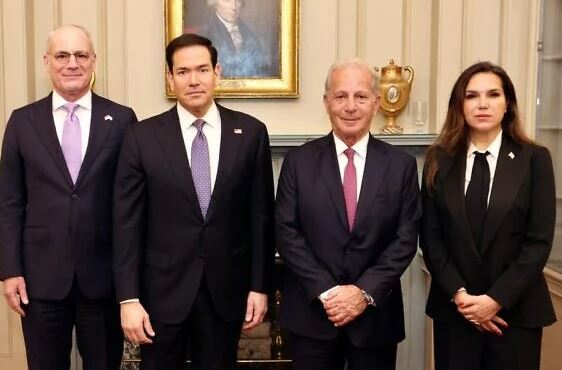
WASHINGTON, MAY 8: The US will host the third round of ambassador-level talks between representatives from Israel and Lebanon on May 14 and 15, a State Department official and an Israeli official confirmed to The Times of Israel on Wednesday.
Joining diplomats from each side will, for the first time, be military representatives, an Israeli official said, adding that the sides would discuss more concrete measures that can be taken to disarm Hezbollah.
While the US has hoped for more senior-level engagement between the two countries, Beirut has bucked US pressure to have Lebanese President Joseph Aoun meet with Prime Minister Benjamin Netanyahu.
Promoted: Jewish Crossroads, Jon Goldberg-Polin
Keep Watching
Aoun said Monday that such a meeting would only be appropriate after the sides reach a security agreement and after Israel halts its strikes in Lebanon.
During the previous two meetings last month — the first of their kind in decades — Israeli and Lebanese representatives discussed a framework for an eventual peace deal that would see Israel withdraw from Lebanon, an empowered Lebanon disarm Hezbollah, and Jerusalem and Beirut normalize relations.
Beirut agreed to the meetings, hoping they would lead to a halt of Israeli fire in Lebanon. Two days after their first sit-down on April 14, the US announced such a ceasefire.
From left, US Ambassador to Israel Mike Huckabee, Israeli Ambassador to the US Yechiel Leiter, Vice President JD Vance, Secretary of State Marco Rubio, Lebanese Ambassador to the US Nada Hamadeh Moawad and US Ambassador to Lebanon Michel Issa, listen to President Donald Trump speak in the Oval Office at the White House, April 23, 2026, in Washington. (AP/Mark Schiefelbein)
The second meeting — attended by US President Donald Trump — on April 23 saw the US announce a three-week extension of that truce.
The ceasefire has not been felt in southern Lebanon, where Israel carries out daily strikes against what it says are Hezbollah operatives and infrastructure, and the Iran-backed terror group targets Israeli troops that have established a six-mile buffer zone beyond the border, which Jerusalem says is for protecting its northern communities from enemy fire. Hezbollah has also frequently targeted northern Israel with rockets and drones.
Advertisement
While the US has okayed Israeli strikes in Lebanon against targets that Jerusalem deems a threat, it has drawn a line on strikes in Beirut, which until Wednesday had gone untouched since early April. Israel justified the apparent ceasefire violation by arguing that the senior Hezbollah operative it targeted was responsible for planning attacks on Israeli forces.
The US has also used the negotiations in Washington to try and separate Lebanon from its ceasefire talks with Iran, which has tried to demonstrate its influence in Beirut by insisting on merging the two files.
Iran and Pakistani mediators said last month that an April 7 truce between the US and Iran covered Lebanon as well — a charge the US denied, even though Washington went on to pressure Israel to agree to a ceasefire in Lebanon nine days later, as the US sought to prevent its deal with Tehran from collapsing.
While Aoun’s government is the first in decades to express a desire to curb Hezbollah’s influence in the country, the Iran-backed terror group still wields significant influence in Lebanon, and a relatively weak Beirut is trying to act without sparking another civil war with the roughly one-third of the country’s population that is Shiite.
Smoke rises following several Israeli airstrikes that hit without previous warning Beirut’s southern suburbs and central Beirut, Lebanon, April 8, 2026. (AP/Hassan Ammar)
Accordingly, Aoun quietly pushed back on US calls for him to meet Netanyahu in person, particularly while Israeli forces continue to occupy such a large buffer zone in southern Lebanon. The Israel Defense Forces has been razing homes in almost every Lebanese village along the border, saying they have been used to either store Hezbollah weapons or that they can be used to target Israel. The demolitions have created scenes reminiscent of the destruction in Gaza, sparking growing international outcry.
Israel says the buffer zone is necessary to protect northern communities from Hezbollah attacks, while critics of the policy argue it legitimizes the terror group, which claims to be acting to defend Lebanon’s sovereignty.
Israeli forces have been coming under constant Hezbollah drone fire in southern Lebanon, where the IDF withdrew from a similar buffer zone over two decades ago after nearly two decades.
Israeli strikes have killed almost 2,700 people in Lebanon since Hezbollah sparked the latest war by attacking Israel in solidarity with Iran, including dozens since the ceasefire, according to Lebanon’s health ministry. The Israeli military has said that it has killed over 1,900 Hezbollah operatives, including hundreds of members of the terror group’s elite Radwan force, since the escalation of hostilities.