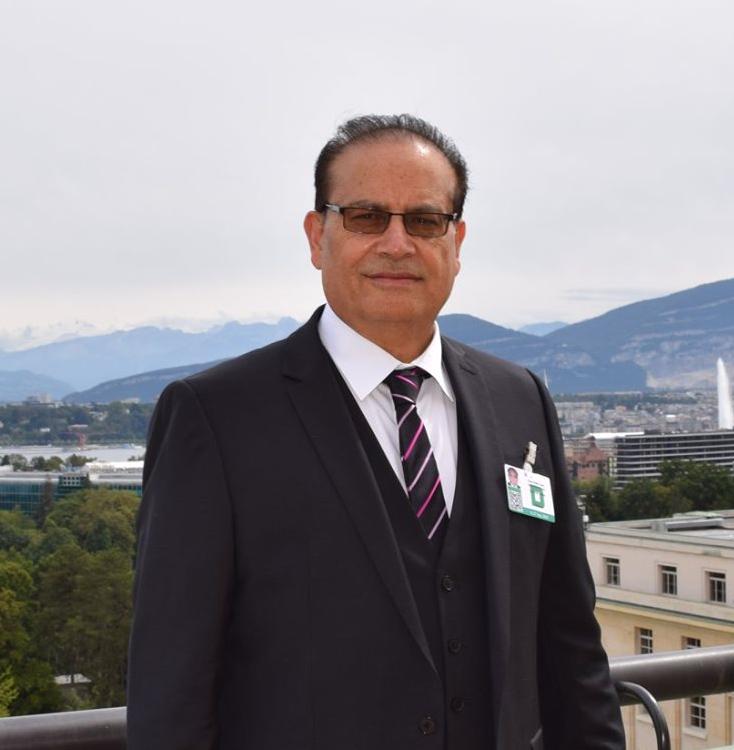
Qamar Bashir
The ongoing war involving Iran has exposed a profound paradox, a striking contradiction, a concealed truth, and a manufactured lie. At its core lies a deeply unsettling question: who defines terrorism, and by what moral authority? The very states that stand accused globally of war, civilian casualties, and widespread destruction are the ones labeling another nation—Iran—as a “terrorist state.” This contradiction is not merely political; it is philosophical, moral, and deeply human.
If one were to objectively assess Iran’s historical conduct, the narrative becomes far more complex than the labels suggest. Iran, for centuries, has not engaged in expansionist wars in the way major global powers have. Unlike repeated military interventions seen in Iraq, Afghanistan, and elsewhere, Iran’s posture has largely been framed as defensive or reactive within its sphere of influence. Yet, despite this, it continues to be branded as the “world’s leading sponsor of terrorism.”
This labeling becomes even more paradoxical when juxtaposed against the actions of powerful nations. The United States has been involved in prolonged wars—from Vietnam to Iraq and Afghanistan—resulting in immense civilian suffering. Similarly, Israel’s military operations have drawn sustained criticism for disproportionate force. Yet these actions are rarely framed within the same terrorism narrative. Power, it seems, does not merely influence outcomes—it defines vocabulary.
The contradiction deepens further when examining the language used by political leadership. In recent months, figures such as Donald J. Trump, Marco Rubio, and Pete Hegseth have employed rhetoric that is not only confrontational but deeply dehumanizing. Iranian leaders have been described as “lunatics,” “religious fanatic zealots,” and “radical clerics,” while their military has been portrayed as “decimated,” “rats running,” or facing “certain death.” Statements such as “annihilate,” “wipe out,” and “no mercy” reflect not diplomacy, but domination.
In the current 2026 conflict—widely referred to as Operation Epic Fury—this language has reached a new and alarming intensity. The successive elimination of Iran’s top leadership through three coordinated waves of U.S.-Israeli strikes has been framed not as a tragic necessity of war, but as a moment of triumph. President Trump described the killing of Ali Khamenei as “justice for the world,” calling him “one of the most evil people in history,” while declaring the Iranian regime “decimated, destroyed—they’re all dead.” He dismissed subsequent leadership tiers as “mostly dead,” suggesting that Iran’s governing structure had been “wiped out” and replaced by something more “reasonable.”
Meanwhile, Secretary Hegseth adopted a tone that stripped away even the last remnants of diplomatic civility, remarking that the remaining Iranian leaders were “toast,” boasting that “Trump got the last laugh,” and repeatedly describing the campaign as one in which targets were “hunted down and killed.” He went so far as to characterize this approach as “negotiating with bombs.” Secretary Rubio reinforced this posture, referring to Iranian leaders as “religious fanatic lunatics” and stating that those who once engaged diplomatically with the United States were now “no longer on planet Earth.”
When these remarks are placed in the broader equation of diplomacy, commerce, and international order, they reveal something far deeper than policy—they expose a mindset. A mindset in which the elimination of leadership is celebrated, where human beings are reduced to targets, and their deaths to rhetorical victories. The language—“wiped out,” “toast,” “hunted,” “no longer on planet Earth”—is not merely undiplomatic; it is profoundly cruel, shockingly heartless, and reflective of an extraordinary level of hubris. It suggests a worldview in which power grants the right not only to kill, but to celebrate killing.
Yet, strikingly, Iran’s official responses have largely avoided descending into similar linguistic hostility. While firm and assertive, Iranian leadership has generally refrained from using overtly dehumanizing language against American or Israeli leaders. This asymmetry in discourse reveals another dimension of the paradox: the side with overwhelming military superiority often adopts the most aggressive rhetoric, while the targeted state attempts to retain diplomatic restraint.
Another dimension of this conflict lies in the proportionality of violence, and here the numbers tell a far more revealing story than rhetoric. In Iran alone, approximately 3,486 people have been killed, including 1,568 civilians and at least 236 children and more than 20,000 wounded, Lebanon has reported over 1,200 deaths, including at least 124 children, as Israeli strikes intensified across its territory. In stark contrast, Israel reports 19 civilian deaths, alongside a small number of military casualties, while the United States has recorded 13 military deaths and no significant civilian losses on its own soil. Elsewhere, countries such as Iraq have reported around 100 deaths, with additional casualties scattered across Gulf states, Syria, and other affected regions.
If terrorism is defined as violence against civilians to achieve political objectives, then the clarity of labeling becomes increasingly blurred. Can a state responsible for large-scale civilian destruction still claim exclusive moral authority? Or does power itself redefine morality?
Historically, legitimacy has often been shaped not by actions alone, but by control over narrative. The ability to define terms, to repeat them through global media, and to embed them into public consciousness has allowed powerful nations to position themselves as arbiters of justice—even when their actions are contested.
The war has also exposed the strategic use of information. From the outset, claims that Iran’s capabilities had been “90 percent degraded” were widely circulated. Yet, continued retaliatory strikes and sustained operational capacity challenge these assertions. The gap between declared success and observable reality highlights how information itself has become a weapon of war.
Iran, by contrast, has maintained a relatively consistent message: that any attack on its territory would be met with reciprocal force. Whether through threats to energy routes, regional strikes, or broader escalation signals, its actions have largely aligned with its stated doctrine. This consistency stands in contrast to the shifting narratives and evolving justifications presented by its adversaries.
The Iran conflict is therefore not merely a military confrontation—it is a battle over definitions: of terrorism, legitimacy, and morality. It forces the world to confront uncomfortable truths about power and perception, and to question whether moral authority truly lies with those who possess the greatest force.
In the end, the paradox remains unresolved. A nation labeled as a terrorist state asserts its right to defend itself, while those waging war in the name of security claim moral superiority. Between these competing narratives lies a complex and often uncomfortable reality—one that cannot be reduced to slogans or labels.
The true measure of humanity is not in the ability to dominate, but in the capacity to uphold dignity even in conflict. If the language of war continues to strip away that dignity, then the line between justice and aggression will fade into obscurity. And perhaps that is the most dangerous truth of all.
Qamar Bashir
Press Secretary to the President (Rtd)
Former Press Minister, Embassy of Pakistan to France
Former Press Attaché to Malaysia
Former MD, SRBC | Macomb, Michigan