
By Mansoor Nizamani
On 24 June 2026, Venezuela experienced one of the darkest days in its modern history when two powerful earthquakes, measuring 7.1 and 7.5 on the Richter scale, struck several parts of the country, causing widespread devastation. Within seconds, panic and chaos spread as people rushed out of their homes, offices, and commercial buildings in a desperate attempt to save their lives. In many cities, daily life came to a standstill, while the government immediately activated emergency measures and mobilized all relevant institutions. This natural disaster has become a new and formidable challenge for Venezuela, a nation already struggling with severe economic and social crises. Its consequences are expected to affect the country for many years to come.
Geographically, Venezuela is situated along the boundary of the Caribbean and South American tectonic plates, making it one of the earthquake-prone countries in the region. The continuous movement of these tectonic plates generates enormous pressure beneath the Earth’s surface, which is suddenly released in the form of powerful earthquakes. History shows that Venezuela has experienced several devastating seismic disasters. The 1812 earthquake remains one of the deadliest in the country’s history, while the 1967 Caracas earthquake also resulted in significant loss of life and widespread destruction. Consequently, seismologists and disaster management experts have consistently classified the region as highly vulnerable and have stressed the importance of enforcing earthquake-resistant building standards.
According to reports, the epicenter of both earthquakes was located near Morón, while strong tremors were also felt in the capital city of Caracas, as well as La Guaira, Miranda, Carabobo, and Yaracuy. More than 138 aftershocks were recorded following the main earthquakes, prolonging fear and uncertainty among residents. Thousands of families evacuated their homes and sought refuge in parks, open grounds, and other safe locations. Schools, colleges, and government offices in several affected areas were temporarily closed, while engineers and structural experts began inspecting buildings to determine their safety. Fear and uncertainty continue to grip residents, preventing life from returning to normal.
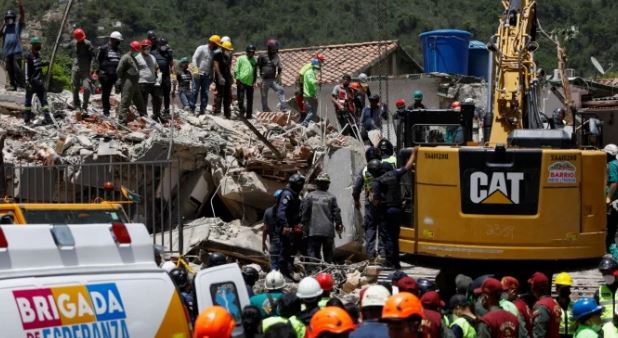
According to the latest reports, the death toll has risen to 1,430, while more than 3,238 people have been injured. Many individuals remain missing, and authorities fear that numerous victims are still trapped beneath the rubble of collapsed buildings, raising concerns that the number of fatalities may continue to increase. Search and rescue teams are working around the clock using heavy machinery, trained personnel, rescue dogs, and advanced equipment to locate and save survivors. A state of emergency has been declared in many hospitals, where doctors, nurses, and medical staff are working under immense pressure to treat the growing number of injured people. Temporary field hospitals have also been established, while nationwide blood donation campaigns have been launched to meet the urgent medical needs.
The disaster has also dealt a severe blow to Venezuela’s fragile economy. According to preliminary estimates by the United Nations, the country has suffered approximately US$6.7 billion in economic losses, placing an enormous burden on an economy that was already facing significant challenges. Roads, bridges, residential buildings, hospitals, schools, electricity grids, water supply systems, and communication networks have been extensively damaged or destroyed. Many factories, commercial centers, and industrial facilities have suspended operations, directly affecting employment, trade, and economic activity. Economists believe that rebuilding damaged infrastructure, restoring essential public services, and reviving economic stability will require long-term planning and sustained international cooperation.
Following the disaster, the Venezuelan government mobilized the military, police, civil defense authorities, and other emergency response agencies on an urgent basis. Search and rescue teams have been working tirelessly to pull survivors from the rubble, transport the injured to hospitals, and distribute food, clean drinking water, medicines, tents, and other essential supplies to affected communities. Emergency shelters have also been established for families who lost their homes or were forced to evacuate due to safety concerns.
The international community has expressed solidarity with Venezuela by actively supporting relief and rescue operations. The United States, Spain, the Netherlands, Türkiye, Brazil, and several other countries have announced humanitarian assistance, including rescue specialists, medical teams, emergency equipment, and relief supplies. Meanwhile, the United Nations, UNICEF, and other international organizations are focusing on child protection, access to clean water, healthcare services, sanitation, and psychological support for survivors. Experts emphasize that, following major natural disasters, emotional and mental recovery is just as important as physical rehabilitation.
Natural disasters do not only cause immense human suffering and economic losses; they also test a nation’s preparedness, emergency response systems, construction standards, and institutional capacity. The earthquakes in Venezuela once again demonstrate that while humanity cannot prevent the forces of nature, the impact of such disasters can be significantly reduced through scientific planning, resilient infrastructure, strict enforcement of earthquake-resistant building codes, effective emergency response mechanisms, and greater public awareness.
This tragedy also serves as an important reminder to the international community that natural disasters recognize no national boundaries. In times of crisis, compassion, solidarity, humanitarian values, and international cooperation become humanity’s greatest strengths. The willingness of nations to help one another during emergencies reflects the shared responsibility of protecting human life regardless of borders or political differences.
Although the road to recovery will undoubtedly be long and challenging, there is hope that sustained relief efforts, well-planned reconstruction programs, and continued international cooperation will help Venezuela rebuild its damaged infrastructure and restore essential public services. Above all, it is hoped that the affected families will find the strength, resilience, and determination to rebuild their lives and look toward the future with renewed hope.