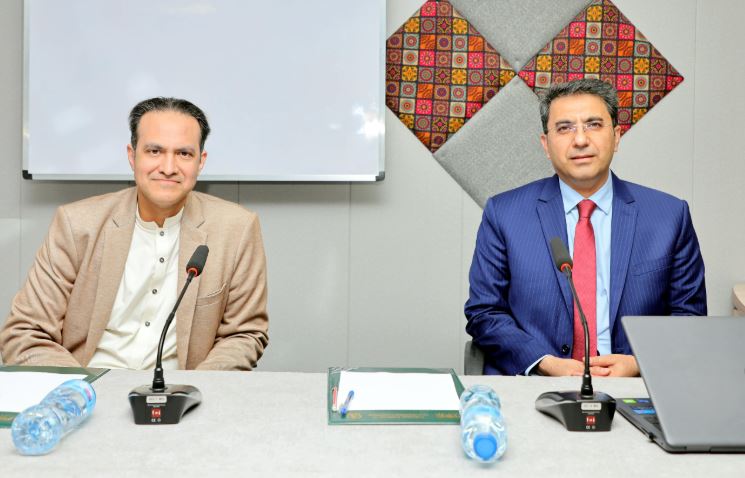
ISLAMABAD, APR 15 /DNA/ – The Pakistan Institute of Development Economics (PIDE) hosted a high-level seminar titled “Minerals & Economic Development: Prospects for Pakistan,” bringing together scholars, policymakers, and development practitioners to examine how Pakistan can convert its mineral potential into inclusive and sustainable economic progress. Opening the session, PIDE Vice Chancellor Dr. Nadeem Javaid (SI) observed that natural resources have shaped the rise and fall of nations, from the silver mines of ancient economies to the energy geopolitics of the modern world. He noted that the central question remains unchanged: why some countries are able to turn resource wealth into prosperity, while others continue to struggle.
Dr. Javaid said Pakistan stands at an important juncture, with growing interest in minerals as a possible source of foreign exchange and long-term growth, while also facing persistent challenges related to governance, energy constraints, security concerns, and institutional capacity. He framed the seminar around four central questions: whether mineral wealth can support sustainable development or reinforce inequality and volatility, what distinguishes countries that escape the resource curse from those that remain trapped in it, where Pakistan currently stands on this spectrum, and what a realistic, policy-driven mineral development strategy for the country should look like.
The seminar featured Prof. Saleem H. Ali, Chair and Distinguished Professor at the University of Delaware, affiliated with the University of Queensland, and a member of the UN International Resource Panel, as the keynote speaker. Introducing him, PIDE highlighted Prof. Ali’s extensive global work on extractive industries, environmental conflict resolution, and sustainability, noting his academic, policy, and field experience across more than 160 countries. Dr. Javaid noted that Prof. Ali’s work bridges global scholarship and policy practice in extractive industries and sustainable development, and expressed hope that his insights would help illuminate a practical way forward for Pakistan. Setting the tone for the discussion, he asked what one reform or strategic decision Pakistan should prioritize in the minerals sector.
In his address, Prof. Ali argued that minerals have historically played a foundational role in economic transformation and remain deeply linked to modern prosperity, even in service-led economies. Drawing on both economic history and contemporary policy debates, he emphasized that mineral wealth alone does not guarantee development; what matters is whether countries build the institutions, policy frameworks, and reinvestment mechanisms needed to turn resource endowments into broad-based national gains.
A major theme of the seminar was the need to move beyond simplistic narratives of mineral abundance. Prof. Ali cautioned against confusing resources with reserves, stressing that only economically viable and extractable reserves should inform serious planning. He also revisited the ideas of the “resource curse,” the “Dutch disease,” and the “paradox of plenty,” noting that while mineral-led growth can create wealth, it can also deepen inequality, distort institutions, and weaken alternative sectors if not managed wisely. At the same time, he underlined that these outcomes are not inevitable. Countries that combine investment, learning, transparency, and effective governance can transform extractive sectors into drivers of national development.
Discussing Pakistan’s options, Prof. Ali outlined several mineral development pathways, including large transformative projects with royalties and fiscal flows, infrastructure minerals linked to construction and connectivity, energy minerals, and the branding of Pakistani gemstones for global commercial markets. He stressed that the real economic impact of mining does not lie only in taxes and royalties, but also in backward and forward linkages such as local procurement, services, employment clusters, entrepreneurship, and downstream activity. He further observed that while large industrial mines often create limited direct jobs, smaller-scale “development minerals” and associated local industries can generate wider employment opportunities if properly supported.
Referring to Reko Diq as Pakistan’s most prominent mineral project, Prof. Ali described it as one of the world’s largest copper-gold developments currently underway and a potentially transformative opportunity for the country. However, he argued that the real test lies not simply in extraction, but in ensuring transparent governance, effective fiscal use, and developmental reinvestment. He noted that security concerns, while often highlighted, are not necessarily the decisive barrier for global mining firms; rather, investors are often more concerned about governance failures and resource capture. In this context, he pointed to international examples and recommended that Pakistan consider stronger transparency mechanisms and more deliberate development planning around major mineral projects.
The seminar also gave significant attention to local benefit-sharing, especially in Balochistan. During the discussion, Prof. Ali argued that mineral-rich regions must see visible and measurable development gains from extraction taking place in their areas. Citing international practice, he referred to Peru’s model of reinvesting a portion of mineral-related development expenditure in the producing region and suggested that Pakistan could consider similar arrangements. He stressed that relying solely on formal revenue shares is not enough; meaningful reinvestment in local communities is essential for improving development indicators, reducing grievances, and building long-term legitimacy around mineral development.
Another major point raised during the seminar was value addition. Prof. Ali noted that processing minerals domestically is an important long-term goal, but warned that it requires three conditions at once: reliable and affordable energy, skilled labour, and strong governance. Without these, forced value addition can become economically counterproductive. He also encouraged Pakistan to think beyond conventional extraction by exploring gemstone branding, circular economy opportunities, and “urban mining” through metal recovery from existing waste and infrastructure. He suggested that the country should also examine the future potential of a minerals-focused sovereign wealth approach based on actual windfall revenues, alongside scenario modelling and research on long-term development impacts.
In his concluding remarks, PIDE Vice Chancellor Dr. Nadeem Javaid underscored that natural resources alone do not determine a nation’s future. He noted that what truly matters is how effectively a country governs its resources, invests in their productive use, and builds strong institutions around them. He said this is where both the real challenge and the real opportunity lie for Pakistan. He further expressed hope that the ideas shared during the seminar would inspire deeper research, informed policy adaptation, and practical application in the Pakistani context for the country’s long-term benefit.
The seminar concluded with an interactive question-and-answer session, during which participants engaged with the speaker on key policy, governance, and provincial development issues related to Pakistan’s mineral sector.