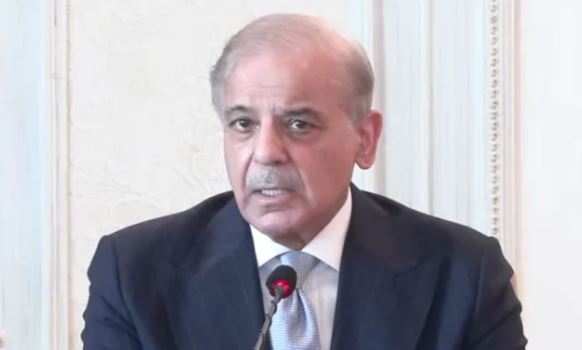
ISLAMABAD, APR 13: Prime Minister Shehbaz Sharif on Monday said that Pakistan remains fully engaged in efforts to resolve pending issues between the United States and Iran, commending the political and military leadership for their role in hosting the historic talks in Islamabad.
Islamabad emerged as key mediator in the US-Iran war after PM Shehbaz mediated a two-week ceasefire between the two side on April 8. Delegations from Washington and Tehran then arrived in Islamabad and held negotiations for over 20 hours at his invitation over the last weekend. However, the negotiations could not result in an agreement.
Addressing the federal cabinet, the prime minister said that Pakistan played an important role in bringing the United States and Iran to the table after around 47 years, noting that both delegations visited Pakistan at Islamabad’s request.
He said the talks marked the first time the two sides had engaged in direct, face-to-face dialogue at such a level, with discussions continuing for 21 hours.
PM Shehbaz added that Pakistan’s leadership worked tirelessly to make the negotiations possible.
The prime minister also expressed gratitude to the US and Iran for accepting Pakistan’s invitation, saying both delegations appreciated the country’s hospitality and acknowledged its constructive role.
He maintained that Pakistan’s efforts had helped sustain the two-week ceasefire, while attempts were ongoing to resolve outstanding issues.
He said that Pakistan was able to step in as a mediator and contribute positively to regional stability at a time when the global economy was reeling from the conflict.
The Islamabad talks lasted around 21 hours and marked the first direct US-Iran meeting in over a decade, as well as the highest-level discussions since Iran’s 1979 Islamic Revolution.
The US delegation, led by Vice President JD Vance, included President Donald Trump’s special envoy, Steve Witkoff, and his son-in-law Jared Kushner.
The Iranian delegation was led by Parliament Speaker Mohammad Bagher Ghalibaf, included Foreign Minister Abbas Araghchi.
The negotiations aimed at ending six weeks of fighting that has killed thousands of people across the Gulf and throttled vital supplies of energy and sparked fears of a wider regional conflict.
The conflict in the Middle East began on February 28, when the US and Israel launched a joint bombing campaign against Iran.
The scope quickly expanded as Iran effectively blocked the Strait of Hormuz and launched attacks against Israel and US bases in the Middle East.
The war has buffeted global financial markets and caused thousands of civilian deaths, mostly in Iran and Lebanon.